Kunjungan saya ke dua kota suci Mekah dan Madinah di tahun ini bukanlah kunjungan kali pertama dalam kehidupan saya. Meski demikian, Allah masih memberi kesempatan dan sayang-Nya kepada saya untuk sujud begitu dekat dengan-Nya di dua tanah suci. "Rejeki tiban" yang saya dapatkan di tahun ini berasal dari Atase Agama Kedutaan Besar Kerajaan Saudi Arabia di Jakarta. Undangan haji ini saya terima pada saat saya sedang memimpin rapat di Fakultas tanggal 10 September jam 11.00.Tiba-tiba saya dihubungi oleh salah seseorang dari Kementerian Agama bahwa ada undangan untuk menunaikan ibadah haji atas biaya Atase Agama. Orang ini mengaku bernama Bil Bakhtiar. Saya bertanya kepada orang yang menelepon saya, "Bapak tahu nomor telepon saya dari siapa?". Lalu orang ini menjelaskan "sanad" diperolehnya telepon dengan menyebutkan nama-nama orang yang saya kenal. Kemudian saya kembali bertanya, "Apakah Bapak meminta saya untuk mencari orang yang mau berangkat haji?". Orang dari Kemenag ini menjawab bahwa undangan ini direkomendasikan untuk saya, bukan untuk meminta saya mencarikan orang untuk naik haji. Spontan saya katakan bersedia untuk jadi tamu Allah di musim haji tahun ini. Pikirku, namaku muncul adalah kehendak Allah SWT yang tidak boleh ditolak, ini adalah takdir yang harus aku lalui.
Namun ada hal yang mengganggu benak saya dalam obrolan per telepon tersebut. Tanggal keberangkatan belum jelas karena menunggu kepastian dari kedutaan Saudi. Saya katakan, "Baiklah, saya menunggu kabar Anda selanjutnya. Terima kasih saya sudah diberitahu. Jazakumullah Mas." Saat itu hati saya berbunga-bunga mendapatkan tawaran spontan ini. Saya meyakini bahwa tawaran ini merupakan undangan dari Allah SWT bagi saya untuk menyempurnakan manasik kehidupan. Kalau sekedar manasik haji, maka yang terbayang adalah olah fisik dan runutan ritual dari mulai ihram hingga thawaf wada' (tawaf perpisahan). Manasik kali ini adalah untuk memperbaiki kehidupan saya. Saya berhajat untuk melaporkan diri ini kepada Sang Khaliq di tempat suci. Memang dalam kunjungan terakhir tahun 2008, saya sempat meminta kepada Allah di saat tawaf wada' agar saya diberi kesempatan untuk menengok dua kota suci lagi untuk menyempurnakan diri. Angan saya melayang pada momen haji tahun itu betapa banyak kekurangan ibadah yang belum sempat saya sempurnakan. Ternyata doa saya terjawab, alhamdulillaaah.
Tanggal 19 September saya ditelepon oleh Habib Haidar dari LIPIA bahwa nanti saya akan diberangkatkan dalam rombongan dosen dan karyawan LIPIA yang diperkirakan pada tanggal 28 September 2014. Beliau menginginkan saya membereskan proses vaksinasi segera dan menyerahkan kartu kuning ke kantor LIPIA. Karena saya baru dikasih tahu hari Kamis, maka saya baru bisa mengikuti vaksinasi pada hari Senin, karena Jumat merupakan hari kejepit. Saya rencanakan tanggal 22 September hari Senin untuk mendapatkan dua suntikan: meningitis dan flu. Saya mendapatkan informasi bahwa RS Fatmawati memberi layanan vaksinasi untuk haji dan umroh. Tepat jam 6.30 tanggal 22 September, saya sudah nangkring di atas motor andalan untuk meluncur ke Fatmawati. Saya siapkan fotokopi pasaport dan dua lembar pas foto ukuran 4X6 cm untuk persyaratan mendapatkan vaksinasi tersebut. Kutancap motor menuju Fatmawati menyelusuri jalan Cirendeu Raya kemudian jalan Adhyaksa menuju RS Fatmawati. Jam segitu suasana jalanan sudah padat dan seperti biasa deretan mobil mengular sepanjang jalan. Ungunglah dengan mengendarai motor, saya bisa sampai relatif lebih cepat. Sampai di pelataran parkir RS Fatmawati jam 7.00 dengan harapan bisa mendapatkan antrian dengan nomor muda. Saya pun memarkir kendaraan di area parkir sepeda motor yang saya lihat sudah banyak deretan motor. Tanpa tanya ini dan itu, saya parkir saja motor di situ. Nah, saat itu saya melihat seorang petugas parkir sedang berdiri di pojokan; seorang pria yang kutaksir usianya di akhir 50an memakai kaos putih dan bertopi kuning. Saya bertanya padanya, "Pak saya sudah parkir motor saya di sini apakah tidak diberi karcis?". Mendengar jawabanku tersebut, petugas parkir langsung memberitahu saya bahwa saya salah parkir karena area parkir tersebut khusus diperuntukkan bagi karyawan Rumah Sakit. Olala.....baru tahu kalau saya masuk area privilese. Tahu begitu saya tak bertanya tentang karcis parkir deh (demikian bisikan nakal dalam otak saya..hehehe). Tapi ada untungnya saya bertemu dengan lelaki ini, karena saya bisa bertanya tentang layanan vaksinasi haji dan umroh di RS Fatmawati. Ketika saya tanya tentang hal ini, si petugas parkir ini menjawab, "Maaf Pak, setahu saya layanan tersebut sudah tutup lebih dari setahun. Tapi untuk memastikan bahwa silahkan saja pergi ke gedung sebelah untuk mendapatkan informasi yang lebih lengkap."
Saya manut saja ucapan laki-laki tersebut. Saya pun ngloyor menuju aula poliklinik sebagaimana yang ditunjuk oleh petugas parkir tadi. Sepanjang langkah kaki saya berjalan di trotoar rumah sakit yang rindang. Saya melihat bahwa suasana pagi pun rumah sakit sudah begitu ramai. Dalam hati saya berdoa, "Ya Allah berikan hamba-Mu ini kesehatan agar dapat bermanfaat bagi banyak umat. Meski kamar rumah sakit berhiaskan AC dan teve, jangan Kau masukkan aku ke sana menjadi manusia sakit." Begitu dekat dengan gedung yang dimaksud, saya melihat seorang laki-laki berseragam biru-biru mengenakan top biru juga di kisaran usia 30 tahunan sedang mengatur mobil yang berhenti menurunkan penumpang di depan poliklinik. Suasana lantai dasar poliklinik sudah ramai luar biasa. Semua kursi yang tersedia dipenuhi pasien dan keluarga pasien untuk mendaftar. Tidak sedikit di antara mereka terpaksa berdiri menunggu giliran. Suasana ramai seperti ini pun terjadi di gedung sebelah yang menempelkan spanduk pelayanan BPJS Kesehatan. Betapa mahalnya harga sebuah kesehatan manakala manusia rela antri untuk mendapatkan layanan kesehatan. Kesehatan adalah amanah Allah yang sering manusia lupakan. Seolah kondisi sehat adalah sesuatu yang alami dan "taken for granted". Manusia tidak ambil pusing bahwa titipan Tuhan ini bisa saja berubah menjadi sakit manakala manusia tak lagi peduli dengan hak tubuhnya dan asupan makanannya. Kepada petugas ini saya juga bertanya hal yang sama. Jawabannya adalah, "Sudah lebih dari setahun Pak, layanan vaksinasi sudah ditutup. Saya tidak tahu mengapa ditutup padahal banyak lho yang ngantri. Nah, sekarang Bapak bisa mendapatkan vaksinasi di Bandara Halim dan Bandara Cengkareng (maksudnya Soekarno Hatta)." Voila, kok yah informasi di website belum juga dihapus sih. Saat itu juga saya cabut dari area Rumah Sakit dan menelepon Slamet untuk mengantar ke Layanan Kesehatan di Bandara Halim Perdanakusuma.
Ku cegat Slamet di depan kampus PTIQ Lebak Bulus sembari aku bisa parkir motorku di situ. Perjalanan menggunakan mobil harus lebih super sabar karena berbagi lahan jalan dengan pengendara lain. Ku lirik jam tangan menunjukkan pukul 7.30 pagi. Ntahlah saya tidak tahu jam berapa sampai sana. Apapun serba mendadak. Untunglah saya masih menyimpan paspor yang berlaku hingga 2018 dengan alias tiga nama "Suparto Soenoko Makrup". Seolah saya sudah menyengaja untuk berangkat ke tanah suci saat saya mengajukan pembuatan paspor dengan alias tiga nama. Tidak tahu persis bahwa di Arab, jamaah wajib memiliki tiga nama. Perjalanan menuju ke sana agak tersendat. Alhamdulillah Slamet tahu jalan menuju Halim dan paham bahwa di sana ada semacam klinik yang melayani calon jamaah haji dan umroh. Tepat jam 9.00 kami sampai di depan klinik layanan vaksinasi tersebut. Dari depan gedung itu terlihat lengang karena saya hanya melihat dua orang laki-laki yang sedang duduk bercengkrama. Ku telusuri jendela dan pintu kali-kali ada kata "LOKET PENDAFTARAN". Bingung juga karena saya tidak mendapatkan kata tersebut di jendela. Akhirnya saya bertanya pada seseorang yang kebetulan lewat di depan gedung tersebut. Orang itu berseragam Dinas Perhubungan. Penampilannnya necis dengan kacamata bening menghiasi tampilan wajahnya. Saya bertanya di mana pendafataran vaksinasi. Dia menjawab bahwa pendaftaran ada di di belakang gedung ini dan lewat lorong samping kanan. Kuturuti apa penjelasan dia. Begitu saya sampai di selasar belakang gedung tersebut, baru saya melihat kerumunan manusia yang sedang antri mendaftar dan sebagian besar sedang duduk di ruang tunggu. Untunglah saya sudah membawa fotokopi paspor dan pas foto, sehingga tak perlu repot untuk memfotokopi. Saya serahkan pada petugas yang menyediakan formulir pendafataran. Dia anak muda yang agak kurus mengenakan topi hitam tanpa ada tanda pengenal atau seragam. Dia mengenakan jaket lusuh hitam. Area tunggu dan pendaftaran serasa begitu sempit karena yang datang ratusan orang. Alhamdulillaah saya mendapatkan nomor urut 108! Jam 9.20 saya mendapatkan nomor urut ini. Lalu saya mencari tempat duduk yang terletak agak mojok ke belakang. Seorang laki-laki sedang menunggu panggilan kulirik urutan angkanya "08". Saya bertanya pada dia sejak jam berapa hadir di Halim. Dia jawab sejak pukul 5 pagi! Wah..wah...wah.... (bersambung)
Sunday, October 19, 2014
Thursday, December 27, 2012
Habibie dan Ainun
Menonton film yang diangkat dari kisah cinta Habibie dan Ainun membuat saya makin mengapresiasi karya-karya sineas Indonesia. Film bermutu semacam ini selayaknya ditonton oleh masyarakat Indonesia untuk mengetahui bahwa kisah cinta ternyata bisa dituangkan dalam karya sinematografi tanpa nuansa murahan. Cinta ditampilkan begitu elegan, fantastis, natural, namun sederhana. Kesederhanaan cinta dalam film ini ditampilkan dengan sangat luar biasa. Kesederhanaan bukan bermakna apa adanya dan cenderung datar. Film ini mampu menyuguhkan makna cinta yang berasal dari hati nurani dua makhluk manusia dengan apik dan cantik. Salut untuk Hanung Bramantio, Reza Rahadian, dan Bunga Citra Lestari.
Sedikit catatan dalam film ini adalah penampakan tokoh yang selalu awet muda dari tahun 1960an hingga tahun 2000an. Saya tak menyangka bahwa Habibie dan Ainun bisa terus muda dalam rentang waktu empat dekade lebih. Penampilan Reza yang menokohkan Habibie pada sisi acting memang luar biasa, namun perubahan fisik Habibie semestinya dimaksimalkan pada diri Reza. Habibie masih saja ramping hingga masa lengsernya Habibie dari kursi kepresidenan. Munculnya pesan sponsor yang vulgar mengurangi konsentrasi menonton film ini, misal munculnya alat-alat komestik bermerek Wardah, satu kaleng biskuit Chocolatos, dan kemunculan e-toll Bank Mandiri di pintu Toll pada saat Habibie berkunjung ke Bandung. Wah..wahh..wahh...
Di samping cinta yang disuguhkan dalam film ini, realitas leadership nasional menjadi tema utama yang tak kalah pentingnya. Habibie menunjukkan keseriusannya untuk menata negeri ini. Meski beliau dipandang sebagai orang dekat Soeharto, namun Habibie menunjukkan gaya kepemimpinan yang unik yang berbeda dengan pendahulunya. Pada masanya, pintu informasi dibuka lebar-lebar dan keran demokrasi diperkenalkan secara masif. Meski harga demokrasi sungguh menyakitkan, Indonesia harus menjadi "the leading democratic country in the world". Timor-Timur lepas dari pangkuan Indonesia adalah biaya mahal yang diakibatkan oleh demokrasi melalui referendum. Cemoohan musuh-musuh Habibie yang melabelkan Habibie sebagai bayang-bayang Orde Baru adalah hal yang menyakitkan hingga dia dituduh telah melakukan korupsi.
Masih ingat dalam benak saya bahwa pada masanya (21 Mei 1998 - 20 Oktober 1999), Habibie sanggup menstabilkan nilai tukar rupiah terhadap dollar yang waktu itu masih berkisar antara Rp 10.000 – Rp 15.000 hingga nilai tukar rupiah menguat pada level Rp 6500 per dolar AS; nilai yang tidak akan pernah dicapai lagi di era pemerintahan selanjutnya.
Meski banyak kreasi positif yang dilakukan Habibie, namun dia harus jatuh dari kursi kekuasaan tanpa pembelaan. Saat dia memasuki gedung MPR dalam acara Sidang Umum MPR tahun 1999, betapa para anggota dewan memaki dan berteriak "huuuuuuuuuuuu" kepada beliau. Sungguh menyakitkan dan tak pantas dilakukan oleh orang-orang terhormat yang mengatasnamakan rakyat. Pidato pertanggungjawabannya ditolak dan Habibie harus lengser dari panggung kekuasaan pada 20 Oktober1999. Seiring dengan turunnya Habibie dari kursi kepredisenan, maka cita-cita nasional untuk memajukan teknologi kedirgantaraan Indonesia pun kandas di jalan. Cita-cita Indonesia memiliki industri pesawat semakin tidak jelas. Padahal pada tahun 1995 pesawat karya anak bangsa CN 250 Gatotkaca pernah melayang di kolong langit Nusantara atas kerja keras dan keseriusan Habibie. Wajar manakala Habibie menangis sesenggukan dalam pelukan Ainun ketika dia memandang sedih CN250 yang teronggok di hangar PT DI dalam kondisi berdebu dan dilupakan sejarah
Berikutnya adalah profesionalisme. Sejelek-jeleknya Soeharto, Beliau masih mau menghargai para profesional, teknokrat, dan ilmuwan anak negeri. Habibie rela pulang kampung ke Indonesia atas sokongan Soeharto dan melepas jabatannya sebagai wakil presiden bidang teknologi pada Messerschmitt-Bölkow-Blohm, sebuah perusahaan penerbangan yang berpusat di Hamburg, Jerman. Bandingkan dengan sekarang di mana orang-orang pintar Indonesia tersebar di seantero dunia. Diaspora intelektual menjadi nyata manakala negeri ini tak mau memberi tempat untuk para ilmuwan idealis yang berniat suci untuk membangun negeri. Ironisnya, Indonesia menjadi sarang intelektual oportunis. Tengoklah pada masa lalu banyak intelektual pengritik pemerintah. Seolah mereka adalah garda moral dan pengusung spanduk kesalehan, namun banyak di antara mereka yang sekarang berenang dalam pusar kekuasaan. Walhasil, kritisisme dan idealisme lenyap bak embun diterpa sinar mentari. Profesionalisme yang ditunjukan Habibie seolah menjadi barang langka di dunia yang dijenuhi oleh fitnah materialisme ini.
Di atas semua, sosok Habibie menjadi sentral dalam alur sejarah nasional Indonesia. Mengapa? di sampingnya ada wanita yang tulus mencintainya. Simak ungkapan Ainun ketika Habibie tak bisa tidur karena memikirkan Timor-Timur, "Jika kamu tidak bisa memimpin tubuh kamu sendiri, bagaimana kamu bisa memimpin 200 juta tubuh yg ada dinegri ini?". Yah, cinta yang menjadi nyawa dalam kehidupan ini menjadikan film ini begitu layak untuk ditonton. Cinta menjadi eliksir dalam hidup.
Ciputat, 26 Desember 2012.
Wednesday, March 21, 2012
Lukisan
Dengan apa akan kulukiskan rasa ini
Sketsa satu warna penuh Magenta,
Wajah senja yang berbalut merah saga,
Atau potret luka yang menganga?
Malam sudah membilang separuh purnama,
Pagi sudah menabuh dua belas subuh,
Cinta kita sejarak seberang benua,
Menunggu genderang waktu yang ditabuh.
Kanvas kosong di depanku
Palet cat minyak di kiriku
Kuas lukis di tangan kananku
dan sketsa kasar di hatiku
Senja demi senja terlewat,
Pagi demi pagi terlalui,
tanganku masih gemetar menggenggam kuas,
Menebalkan lagi sketsa dalam hati..
betapa nyatanya warna rasa,
Betapa rindunya jiwa mendamba,
Betapa indahnya cinta yang bersua.
Menandai gurat yang tegas, lembut, pelan
Memanjang atau menikung
Semua ku guratkan di kanvas kita
Kadang dia realis naturalis bagai lukisan maestro Abdullah atau Soedjojono
Kadang dia abstrak bagaikan goresan Affandi
Atau dia suryalis bagaikan karya Salvador Dali
Namun kadang dia berbentuk kaligrafi karya Umar Khayam
Lukisan itu bercorak macam-macam
Indah menikmatinya
Karena ia dicipta oleh warna hati
Alirannya kaya karena tak berkiblat pada satu rasa
KJ/KR, 9 Maret 2012
Because you loved me
Because You Loved Me
(Celine Dion)
For all those times you stood by me
For all the truth that you made me see
For all the joy you brought to my life
For all the wrong that you made right
For every dream you made come true
For all the love I found in you
I'll be forever thankful baby
You're the one who held me up
Never let me fall
You're the one who saw me through through it all
You were my strength when I was weak
You were my voice when I couldn't speak
You were my eyes when I couldn't see
You saw the best there was in me
Lifted me up when I couldn't reach
You gave me faith 'coz you believed
I'm everything I am
Because you loved me
You gave me wings and made me fly
You touched my hand I could touch the sky
I lost my faith, you gave it back to me
You said no star was out of reach
You stood by me and I stood tall
I had your love I had it all
I'm grateful for each day you gave me
Maybe I don't know that much
But I know this much is true
I was blessed because I was loved by you
You were my strength when I was weak
You were my voice when I couldn't speak
You were my eyes when I couldn't see
You saw the best there was in me
Lifted me up when I couldn't reach
You gave me faith 'coz you believed
I'm everything I am
Because you loved me
You were always there for me
The tender wind that carried me
A light in the dark shining your love into my life
You've been my inspiration
Through the lies you were the truth
My world is a better place because of you
You were my strength when I was weak
You were my voice when I couldn't speak
You were my eyes when I couldn't see
You saw the best there was in me
Lifted me up when I couldn't reach
You gave me faith 'coz you believed
I'm everything I am
Because you loved me
I'm everything I am
Because you loved me
How do i love thee
by Elizabeth Barrett Browning
How do I love thee? Let me count the ways.
I love thee to the depth and breadth and height
My soul can reach, when feeling out of sight
For the ends of being and ideal grace.
I love thee to the level of every day's
Most quiet need, by sun and candle-light.
I love thee freely, as men strive for right.
I love thee purely, as they turn from praise.
I love thee with the passion put to use
In my old griefs, and with my childhood's faith.
I love thee with a love I seemed to lose
With my lost saints. I love thee with the breath,
Smiles, tears, of all my life; and, if God choose,
I shall but love thee better after death.
Tatapanmu
Apakah itu madu di dalam matamu
Manisnya tatapanmu mengalahkan jutaan candu
Ataukah mataku yang rabun sebab rindu
Kerlingmu menusuk mengundang cumbu
Menatapmu hari ini
membuatku memerah
Semerah baju yang sama-sama kita kenakan
Entah apa yang membuat tatapmu begitu indah
Memasung kata-kataku hingga aku hanya bisa terdiam
Tatapmu laksana madu
Sama-sama mempesonaku
Dalam tatap yang penuh makna kuterpaku
Menerjemahkan segala kerlip yang berpendar syahdu
KR/KJ, 21 Maret 2012
Sunday, January 15, 2012
Januari Membasah

Hujan dan Januari malam ini berkonspirasi
Mencipta ritme ketukan di dalam ruang kelam sunyi
Bak bunyi pintu berketuk 5 menit lalu,
Ketukan dengan nada unik yang menghalau galau dan rindu.
Aku tak bisa membeda: apakah ritme itu adalah air mata
atau hujan yang membasahi hampar tanah
Ritme ketukan air semakin pekak dan deras...
Seolah orkestra yang mengiring senyap rasa penuh noktah
Ternyata bukan hujan yang membasah, tapi derai air matamu yang gelisah
Mengalir tanpa kau pinta...kau tahan tanpa kuasa...
Wahai pemilik wajah indah, maukah engkau berkisah?
Tentang asal usual air mata...
apakah ia pertanda suka ataukah dia pemindai duka?
Atau ceritakan tentang pahitnya rasa kecewa dan manisnya jatuh cinta
Konon dua rasa itu adalah bak pergantian siang dan malam
atau bak bergulirnya kristal embun yang menggelinding di sela dedaunan.
Maka mengapalah engkau berduka? Marilah kurangkum engkau dalam pelukku
Dalam dekap hangat sepanjang malam yang menggelayut atap langitmu
Ku harap gemuruh rasa dalam dadamu tak lagi memburu
Hentak liar jantungmu karena risau
kan lembut berdetak dalam dekap cintaku
Kurengkuh engkau agar tak ditinggal waktu
A S, Januari, 2012
Monday, December 12, 2011
غنّيلي شوية شوية
غنّيلي شوية شوية غنّيلي وخود عينيّ
خليني أقول ألحان تتمايل لها السامعين
وترفرف لها الأغصان النرجس مع الياسمين
وتسافر معها الركبان طاويين المراكب طيّ
شوي شوي شوي شوي
المغنى حياة الروح يسمعها العليل تشفيه
وتداوي كبد مجروح تحتار الأطبّة فيه
وتخللي طلام اللّيل بعيون الحبايب ضيّ
شوي شوي شوي شوي
لأغنّي وقول للطير من بدري صباح الخير
والقمر مع الخضّير ويّاي يردّو عليّ
شوي شوي شوي شوي
أحلفلك بربّ البيت يا مصدّق بربّ البيت
لاسحركم إذا غنّيت وارقّص بنات الحيّ
شوي شوي شوي شوي
Sunday, October 02, 2011
MECCA FOR THE RICH
Mecca for the rich: Islam's holiest site 'turning into Vegas'
Historic and culturally important landmarks are being destroyed to make way for luxury hotels and malls, reports Jerome Taylor.
Saturday, 24 September 2011
Behind closed doors – in places where the religious police cannot listen in – residents of Mecca are beginning to refer to their city as Las Vegas, and the moniker is not a compliment.
Click HERE to download graphic: Mecca For The Rich (430.39kB)
Over the past 10 years the holiest site in Islam has undergone a huge transformation, one that has divided opinion among Muslims all over the world.
Once a dusty desert town struggling to cope with the ever-increasing number of pilgrims arriving for the annual Hajj, the city now soars above its surroundings with a glittering array of skyscrapers, shopping malls and luxury hotels.
To the al-Saud monarchy, Mecca is their vision of the future – a steel and concrete metropolis built on the proceeds of enormous oil wealth that showcases their national pride.
Yet growing numbers of citizens, particularly those living in the two holy cities of Mecca and Medina, have looked on aghast as the nation's archaeological heritage is trampled under a construction mania backed by hardline clerics who preach against the preservation of their own heritage. Mecca, once a place where the Prophet Mohamed insisted all Muslims would be equal, has become a playground for the rich, critics say, where naked capitalism has usurped spirituality as the city's raison d'être.
Few are willing to discuss their fears openly because of the risks associated with criticising official policy in the authoritarian kingdom. And, with the exceptions of Turkey and Iran, fellow Muslim nations have largely held their tongues for fear of of a diplomatic fallout and restrictions on their citizens' pilgrimage visas. Western archaeologists are silent out of fear that the few sites they are allowed access to will be closed to them.
But a number of prominent Saudi archaeologists and historians are speaking up in the belief that the opportunity to save Saudi Arabia's remaining historical sites is closing fast.
"No one has the balls to stand up and condemn this cultural vandalism," says Dr Irfan al-Alawi who, as executive director of the Islamic Heritage Research Foundation, has fought in vain to protect his country's historical sites. "We have already lost 400-500 sites. I just hope it's not too late to turn things around."
Sami Angawi, a renowned Saudi expert on the region's Islamic architecture, is equally concerned. "This is an absolute contradiction to the nature of Mecca and the sacredness of the house of God," he told the Reuters news agency earlier this year. "Both [Mecca and Medina] are historically almost finished. You do not find anything except skyscrapers."
Dr Alawi's most pressing concern is the planned £690m expansion of the Grand Mosque, the most sacred site in Islam which contains the Kaaba – the black stone cube built by Ibrahim (Abraham) that Muslims face when they pray.
Construction officially began earlier this month with the country's Justice Minister, Mohammed al-Eissa, exclaiming that the project would respect "the sacredness and glory of the location, which calls for the highest care and attention of the servants or Islam and Muslims".
The 400,000 square metre development is being built to accommodate an extra 1.2 million pilgrims each year and will turn the Grand Mosque into the largest religious structure in the world. But the Islamic Heritage Foundation has compiled a list of key historical sites that they believe are now at risk from the ongoing development of Mecca, including the old Ottoman and Abbasi sections of the Grand Mosque, the house where the Prophet Mohamed was born and the house where his paternal uncle Hamza grew up.
There is little argument that Mecca and Medina desperately need infrastructure development. Twelve million pilgrims visit the cities every year with the numbers expected to increase to 17 million by 2025.
But critics fear that the desire to expand the pilgrimage sites has allowed the authorities to ride roughshod over the area's cultural heritage. The Washington-based Gulf Institute estimates that 95 per cent of Mecca's millennium-old buildings have been demolished in the past two decades alone.
The destruction has been aided by Wahabism, the austere interpretation of Islam that has served as the kingdom's official religion ever since the al-Sauds rose to power across the Arabian Peninsula in the 19th century.
In the eyes of Wahabis, historical sites and shrines encourage "shirq" – the sin of idolatry or polytheism – and should be destroyed. When the al-Saud tribes swept through Mecca in the 1920s, the first thing they did was lay waste to cemeteries holding many of Islam's important figures. They have been destroying the country's heritage ever since. Of the three sites the Saudis have allowed the UN to designate World Heritage Sites, none are related to Islam.
Those circling the Kaaba only need to look skywards to see the latest example of the Saudi monarchy's insatiable appetite for architectural bling. At 1,972ft, the Royal Mecca Clock Tower, opened earlier this year, soars over the surrounding Grand Mosque, part of an enormous development of skyscrapers that will house five-star hotels for the minority of pilgrims rich enough to afford them.
To build the skyscraper city, the authorities dynamited an entire mountain and the Ottoman era Ajyad Fortress that lay on top of it. At the other end of the Grand Mosque complex, the house of the Prophet's first wife Khadijah has been turned into a toilet block. The fate of the house he was born in is uncertain. Also planned for demolition are the Grand Mosque's Ottoman columns which dare to contain the names of the Prophet's companions, something hardline Wahabis detest.
For ordinary Meccans living in the mainly Ottoman-era town houses that make up much of what remains of the old city, development often means the loss of their family home.
Non-Muslims cannot visit Mecca and Medina, but The Independent was able to interview a number of citizens who expressed discontent over the way their town was changing. One young woman whose father recently had his house bulldozed described how her family was still waiting for compensation. "There was very little warning; they just came and told him that the house had to be bulldozed," she said.
Another Meccan added: "If a prince of a member of the royal family wants to extend his palace he just does it. No one talks about it in public though. There's such a climate of fear."
Dr Alawi hopes the international community will finally begin to wake up to what is happening in the cradle of Islam. "We would never allow someone to destroy the Pyramids, so why are we letting Islam's history disappear?"
Under Threat
Bayt al-Mawlid
When the Wahabis took Mecca in the 1920s they destroyed the dome on top of the house where the Prophet Mohammed was born. It was thenused as a cattle market before being turned into a library after a campaign by Meccans. There are concerns that the expansion of the Grand Mosque will destroy it once more. The site has never been excavated by archaeologists.
Ottoman and Abasi columns of the Grand Mosque
Slated for demolition as part of the Grand Mosque expansion, these intricately carved columns date back to the 17th century and are the oldest surviving sections of Islam's holiest site. Much to the chagrin of Wahabis, they are inscribed with the names of the Prophet's companions. Ottomon Mecca is now rapidly disappearing
Al-Masjid al-Nawabi
For many years, hardline Wahabi clerics have had their sites set on the 15th century green dome that rests above the tomb holding the Prophet, Abu Bakr and Umar in Medina. The mosque is regarded as the second holiest site in Islam. Wahabis, however, believe marked graves are idolatrous. A pamphlet published in 2007 by the Saudi Ministry of Islamic Affairs, endorsed by Abdulaziz Al Sheikh, the Grand Mufti of Saudi Arabia, stated that "the green dome shall be demolished and the three graves flattened in the Prophet's Masjid".
Jabal al-Nour
A mountain outside Mecca where Mohammed received his first Koranic revelations. The Prophet used to spend long spells in a cave called Hira. The cave is particularly popular among South Asian pilgrims who have carved steps up to its entrance and adorned the walls with graffiti. Religious hardliners are keen to dissuade pilgrims from congregating there and have mooted the idea of removing the steps and even destroying the mountain altogether.
Saturday, September 03, 2011
Friday, July 08, 2011
Zainuddin MZ
Ceramah terakhir beliau pada tanggal 3 Juli 2011 di TEVE One. Kritik membangun untuk pemerintah.
Monday, July 04, 2011
Who is afraid of Islamist rule?
30 June - 6 July 2011
Issue No. 1054
Published in Cairo by AL-AHRAM established in 1875
Who's afraid of Islamist rule?
Fears of political Islam have increased to unprecedented levels both inside and outside Egypt, but are such worries justified, asks Gihan Shahine
===
Whereas Western governments have long been frightened of the rise of political Islam, local fears of Islamists representing political Islam in Egypt have also now peaked, with many liberal, secular and Coptic commentators worrying that the formerly outlawed Muslim Brotherhood will take over the country's parliament in the upcoming elections and establish an Islamic state.
The 25 January Revolution that put an end to three decades of the autocratic regime of former president Hosni Mubarak while not spearheaded by the Islamists has nevertheless provided an unprecedented space of freedom for the Muslim Brotherhood and Salafis to operate. That space has led to major concerns for liberal, secular and Coptic observers inside Egypt and anxiety for Western governments, especially the US and Israel.
The Muslim Brotherhood, outlawed for 30 years under Mubarak's rule and yet long the best organised and best-funded opposition bloc on the political scene, has already formed its own political party and is expected to make a strong showing in the upcoming parliamentary elections. Many analysts expect that the absence of equally strong opposition blocs to rival the Brotherhood will provide it with a rare chance to dominate the parliament.
Meanwhile, the Salafis, whose discourse has long focussed on ritual and spirituality and who steered clear of politics during Mubarak's rule, are suddenly also emerging on the political scene, making a strong showing in the media and also forming two political parties. Such developments have left many secularists, liberals, leftists and Copts scrambling, with many fearing that the Salafis, though sometimes critical of the Brotherhood, will join forces with the latter group in the upcoming elections.
While there have been no studies of how strong the Salafis are in terms of numbers, influence and popularity, some activists speculate that their popularity is strongest in rural areas.
Coptic activist Mona Makram Ebeid is among those who worry that "the Salafis have been brought out from their caves," and she has been quoted by the BBC as saying that "everyone is frightened" and "there is a lot of fear in society and a lot of concern." An equally anxious secularist and editor of Cairo's Democracy Review, Hala Mustafa, similarly told the BBC that the Salafist movement was very influential in Egypt and was trying to "turn Egypt into an Islamic state".
Concerns that the Islamists may dominate the political scene in the immediate future escalated when prominent Islamist intellectual Mohamed Selim El-Awwa and prominent former Brotherhood member Abdel-Moneim Abul-Fotouh declared that they would run in the upcoming presidential elections as independent candidates.
The fact that the Brotherhood had earlier made it clear that it would not contest this year's presidential elections and had cancelled Abul-Fotouh' s membership for violating the group's decision hardly dispelled fears that the country was poised on the brink of Islamist rule. Many observers point to the fact that Egypt is a basically religious nation, adding that many people may be tempted to support the Islamists in the upcoming parliamentary and presidential elections.
Such fears, sometimes seen by other analysts as being exaggerated, have led liberal, secular and Coptic voters to rally forces in attempts to stave off potential political gains by the Muslim Brotherhood and others in the upcoming elections. Meanwhile, liberal and secular activists are pushing for the postponement of the parliamentary elections, in order that their parties, especially those formed after the January Revolution, may have an equal opportunity to organise and contest the Brotherhood.
Leading Coptic businessman Naguib Sawiris is among those pushing for a postponement of the parliamentary elections. As the founder of the secular Free Egyptians Party, Sawiris insists that holding parliamentary elections now would not provide "a fair contest" for his party and nor would it allow any other opposition party to compete with the Brotherhood. If the Islamists do indeed come to dominate the country's next government, a pessimistic Sawiris was quoted as saying, "the dictatorship of Mubarak" will have given place to that of the Muslim Brotherhood.
"That is where Egypt is going now," Sawiris said in press statements, echoing fears among the country's Copts of the rise of the Islamists to political power, notably after the many recent incidents of sectarian rifts in Egypt. If comments from Coptic human rights activist Wagih Yacoub are anything to go by, there may even be signs that the country's Copts are turning into Islamophobes.
" There is no doubt that the Muslim Brotherhood and the Salafis are allies," Yacoub told the Washington-based International Christian Concern (ICC) group recently. " The Brotherhood plays politics, and the Salafis are causing chaos so they can empty Egypt of Christians and make it into an Islamic state. Lots of Egyptian people, including moderate Muslims, are worried. If Egypt becomes an Islamic state, it may mean civil war."
Many analysts insist that such comments blow the situation out of proportion and are unfounded. If public-opinion surveys are anything to go by, the majority of Egyptians "desire a democracy informed by religious values, not a theocracy," and less than one per cent of the population considers Iran to be a political model for Egypt, according to a recent report by Gallup Abu Dhabi, a polling organisation.
Although 96 per cent of Egyptians believe religion to be important, and 92 per cent say that they have confidence in religious institutions, most Egyptians still believe religious leaders should be limited to an advisory role and not have the authority to determine the country's laws, the Gallup report said.
Political analyst Fahmy Howeidy also rejects claims that the Brotherhood or the Islamists constitute a danger to Egypt, or that they will dominate the country's next government. "If someone tells you this flat is haunted, would you listen to him, or would you just dismiss what he says as nonsense," Howeidy asked, describing the claims of Islamist dominance to be similar to such "nonsense".
Fears of the rule of political Islam in Egypt, however, do not necessarily amount to Islamophobia, Howeidy said, who added that "the country's secular and liberal opposition is suffering from a state of anxiety, weakness and defeat after the recent referendum over the constitutional amendments proved that they have little weight or popularity in Egyptian society."
Only 22.8 per cent of the population supported secular and liberal calls for a no vote in the referendum, despite a powerful media campaign, while an overwhelming majority of 77.2 per cent approved the amendments. Although many of those who voted yes were probably seeking stability more than anything else, the result of the referendum was largely interpreted in a religious context on the grounds that the Brotherhood and the Salafis had mobilised for a yes vote in contrast to other political formations.
Current fears of an Islamist takeover in Egypt are also not new. The former regime was always keen to portray the Islamists as constituting a "strategic danger" to the country, and it used the Brotherhood' s popularity to convince the world that if Egypt embraced real democracy, the Islamists would take over and turn Egypt into a theocracy. That false image, according to Howeidy, remains engrained in the minds of many people.
This legacy of phobia of the mythical power of the Islamists, says Manar El-Shorbagi, a professor of political science at the American University in Cairo, has now led to a worrying state of polarisation in the country, even driving some members of the opposition to embrace "undemocratic practices".
El-Shorbagi refers to the current "Constitution First" campaign that is sweeping Egypt, pushing for the drafting of a new constitution ahead of parliamentary elections out of a fear that the Brotherhood will win a majority in parliament and will then use that to monopolise the writing of the new constitution.
El-Shorbagi, who voted against the constitutional amendments, considers this move to be "a serious blow to democracy" because it goes against the wishes of the majority of the population, which voted for a new constitution to be written after the elections and not before. The referendum obliges the upcoming parliament to elect a 100-member committee to draft the new constitution within six months of the parliamentary poll.
"It's like killing democracy before it even starts," El-Shorbagi says. "We have to respect the wishes of the majority."
She insists that fears that the Brotherhood will dominate the upcoming parliament are not well-founded since in the latest student union elections, students belonging to the group did not get more than 24 to 28 seats. "It is no more than phobia," she insists. "The Brotherhood is already alienating support as a result of its recent provocative statements and the arrogance of power." Claims that Egyptians are largely religious and will therefore support the Islamists do not worry El-Shorbagi, who insists that "people are wise enough to make a distinction between religion and the Brotherhood. "
For his part, political activist Yehia El-Qazzaz insists that there is no phobia about the rise of the Islamists, adding that the "Constitution First" campaign is not motivated by fear of them. Instead, El-Qazzaz says that the Brotherhood itself has been trying to create such fears through its provocative media statements, portraying itself as the victim of secularist attacks in attempts to gain public sympathy and mend internal rifts.
"The Brothers, who were subject to decades of repression under Mubarak's rule, have discovered that they cannot work unless they are under pressure," El-Qazzaz told Al-Ahram Weekly in an interview, adding that the sudden space of freedom that had been created by the revolution had itself created rifts within the group.
El-Qazzaz speculated that the group was creating an "alternative enemy" for itself and presenting itself as being the victim of secularist attacks, so that it can unite in the face of such threats and regain the sympathy of the streets.
El-Qazzaz describes himself as a "nationalist Muslim" and not a secularist or a liberal, and he says that he is not an opponent of the Brotherhood. Nevertheless, he too argues that the new constitution should be written ahead of the elections, though "as a guarantee against any manipulation in the drafting of the constitution on the part of the ruling military council" and not because he is afraid that the Brothers will impose Islamic rule.
Even if the Brotherhood wins a majority in the upcoming elections, he says, it will not change the constitution in a way that imposes Islamic law. "The Brothers will not change anything or impose Islamic rule. What they want is a civil state with religious references," El-Qazzaz says.
Michele Dunne, editor of the Arab Reform Bulletin at the Carnegie Endowment for International Peace, similarly discounts the possibility that Egypt will turn into an Islamic state or have an Islamist president. She expects, however, that Islamists will have "a significant presence in the parliament," though this may not be a major worry. "I think that even if you ask the Muslim Brotherhood about their goal, they will say it is not to establish an Islamic state but rather to function within a democratic system," Dunne told the BBC.
The Brotherhood has been enhancing its media presence with assurances that it does not want to establish an Islamic state, but is instead in favour of a civil state informed by religious values and insisting that there is no such thing as theocracy in Islam. The Brotherhood has also insisted that it does not wish to dominate the parliament and will only contest 50 per cent of the seats in the upcoming elections, aiming for around 30 per cent of the seats.
Brotherhood spokesman Essam El-Erian has been quoted in the media as saying that fears of the Islamists are "overblown" since "the Egyptian people are wise enough to have a balanced parliament and are keen to have a civil and a democratic state."
Yet, the Brotherhood' s position on issues pertaining to women and to the country's Coptic Christian minority remains worrying to many. The group was highly criticised recently for statements saying that it would not accept a woman or a Copt as president, and there have been fears that the Islamists will try to impose Islamist ideas on the country if they dominate the next parliament, such as forcing women to wear veils or banning interest on investments.
Many members of the Brotherhood insist that such claims are unfounded, potential presidential candidate Abul-Fotouh telling the popular television talk show Al-Ashira Masaan (10pm) that the Islamists will not attempt to impose their ideas on others or push women into wearing the veil against their will. There can be no compulsion in religion, he said.
The group has also revisited many of its former positions, including those concerning women and religious minorities. Women constitute more than 10 per cent of the Brotherhood' s political party, the Freedom and Justice Party, while the party's vice-chairman is the prominent Coptic intellectual Rafiq Habib.
A recent editorial in the British newspaper The Guardian entitled "Islam in Egypt: fear and fantasy" suggested that people should be more anxious about the future of Egypt than about the Muslim Brotherhood. Although the group is expected to play a major role in future, the editorial argued that it should not provoke fear in others since it is "now less a radical organisation than a conservative one, striving to be relevant to modern needs and divided on how far it can or should trim its policies."
The fact that the Brotherhood long ago renounced violence may also be a major point in the group's favour when it comes to Western concerns about political Islam in Egypt. According to the Washington Post's Scott Wilson, the Obama administration is already "preparing for the prospect that Islamist governments will take hold in North Africa and the Middle East", and it has thus ordered studies to "differentiate between such movements as the Muslim Brotherhood in Egypt and Al-Qaeda."
According to the Washington Post, "the Brotherhood' s mix of Islam and nationalism makes it a far different organisation than Al-Qaeda, which sees national boundaries as obstacles to restoring the Islamic caliphate." Many policymakers in the United States also take Turkey, ruled by an Islamist government, as being a successful model for a mixture of Islam and democracy, though others argue that the "ruling Islamist party [in Turkey] is restrained by the country's highly secular army and court system, a pair of strong institutional checks that countries such as Egypt and Tunisia lack."
Yet, at least on the administration level the United States is trying to adapt to the idea that the Islamists may now be a strong political force in post-revolutionary Egypt. A senior official in the US administration was quoted in the Washington Post as saying that "we shouldn't be afraid of Islam in the politics of these countries... It's the behaviour of political parties and governments that we will judge them on, not their relationship with Islam."
US President Obama has also attempted to come to a new understanding with Islam since he took office, arguing that it does not contradict democracy, and US Secretary of State Hillary Clinton has also been receptive to the idea of Islamist parties participating in shaping the region's political future.
"Political participation, " Clinton said, "must be open to all people across the spectrum who reject violence, uphold equality and agree to play by the rules of democracy."
For his part, Howeidy argues that the United States will not object to any government that guards its interests in the region, even if this means having to work with the Islamists. The real cause for alarm, perhaps, remains the US's most important ally, Israel, "which fears that governments based on religious law will inevitably undercut democratic reforms and other Western values," Wilson wrote in his article in the Washington Post.
Issue No. 1054
Published in Cairo by AL-AHRAM established in 1875
Who's afraid of Islamist rule?
Fears of political Islam have increased to unprecedented levels both inside and outside Egypt, but are such worries justified, asks Gihan Shahine
===
Whereas Western governments have long been frightened of the rise of political Islam, local fears of Islamists representing political Islam in Egypt have also now peaked, with many liberal, secular and Coptic commentators worrying that the formerly outlawed Muslim Brotherhood will take over the country's parliament in the upcoming elections and establish an Islamic state.
The 25 January Revolution that put an end to three decades of the autocratic regime of former president Hosni Mubarak while not spearheaded by the Islamists has nevertheless provided an unprecedented space of freedom for the Muslim Brotherhood and Salafis to operate. That space has led to major concerns for liberal, secular and Coptic observers inside Egypt and anxiety for Western governments, especially the US and Israel.
The Muslim Brotherhood, outlawed for 30 years under Mubarak's rule and yet long the best organised and best-funded opposition bloc on the political scene, has already formed its own political party and is expected to make a strong showing in the upcoming parliamentary elections. Many analysts expect that the absence of equally strong opposition blocs to rival the Brotherhood will provide it with a rare chance to dominate the parliament.
Meanwhile, the Salafis, whose discourse has long focussed on ritual and spirituality and who steered clear of politics during Mubarak's rule, are suddenly also emerging on the political scene, making a strong showing in the media and also forming two political parties. Such developments have left many secularists, liberals, leftists and Copts scrambling, with many fearing that the Salafis, though sometimes critical of the Brotherhood, will join forces with the latter group in the upcoming elections.
While there have been no studies of how strong the Salafis are in terms of numbers, influence and popularity, some activists speculate that their popularity is strongest in rural areas.
Coptic activist Mona Makram Ebeid is among those who worry that "the Salafis have been brought out from their caves," and she has been quoted by the BBC as saying that "everyone is frightened" and "there is a lot of fear in society and a lot of concern." An equally anxious secularist and editor of Cairo's Democracy Review, Hala Mustafa, similarly told the BBC that the Salafist movement was very influential in Egypt and was trying to "turn Egypt into an Islamic state".
Concerns that the Islamists may dominate the political scene in the immediate future escalated when prominent Islamist intellectual Mohamed Selim El-Awwa and prominent former Brotherhood member Abdel-Moneim Abul-Fotouh declared that they would run in the upcoming presidential elections as independent candidates.
The fact that the Brotherhood had earlier made it clear that it would not contest this year's presidential elections and had cancelled Abul-Fotouh' s membership for violating the group's decision hardly dispelled fears that the country was poised on the brink of Islamist rule. Many observers point to the fact that Egypt is a basically religious nation, adding that many people may be tempted to support the Islamists in the upcoming parliamentary and presidential elections.
Such fears, sometimes seen by other analysts as being exaggerated, have led liberal, secular and Coptic voters to rally forces in attempts to stave off potential political gains by the Muslim Brotherhood and others in the upcoming elections. Meanwhile, liberal and secular activists are pushing for the postponement of the parliamentary elections, in order that their parties, especially those formed after the January Revolution, may have an equal opportunity to organise and contest the Brotherhood.
Leading Coptic businessman Naguib Sawiris is among those pushing for a postponement of the parliamentary elections. As the founder of the secular Free Egyptians Party, Sawiris insists that holding parliamentary elections now would not provide "a fair contest" for his party and nor would it allow any other opposition party to compete with the Brotherhood. If the Islamists do indeed come to dominate the country's next government, a pessimistic Sawiris was quoted as saying, "the dictatorship of Mubarak" will have given place to that of the Muslim Brotherhood.
"That is where Egypt is going now," Sawiris said in press statements, echoing fears among the country's Copts of the rise of the Islamists to political power, notably after the many recent incidents of sectarian rifts in Egypt. If comments from Coptic human rights activist Wagih Yacoub are anything to go by, there may even be signs that the country's Copts are turning into Islamophobes.
" There is no doubt that the Muslim Brotherhood and the Salafis are allies," Yacoub told the Washington-based International Christian Concern (ICC) group recently. " The Brotherhood plays politics, and the Salafis are causing chaos so they can empty Egypt of Christians and make it into an Islamic state. Lots of Egyptian people, including moderate Muslims, are worried. If Egypt becomes an Islamic state, it may mean civil war."
Many analysts insist that such comments blow the situation out of proportion and are unfounded. If public-opinion surveys are anything to go by, the majority of Egyptians "desire a democracy informed by religious values, not a theocracy," and less than one per cent of the population considers Iran to be a political model for Egypt, according to a recent report by Gallup Abu Dhabi, a polling organisation.
Although 96 per cent of Egyptians believe religion to be important, and 92 per cent say that they have confidence in religious institutions, most Egyptians still believe religious leaders should be limited to an advisory role and not have the authority to determine the country's laws, the Gallup report said.
Political analyst Fahmy Howeidy also rejects claims that the Brotherhood or the Islamists constitute a danger to Egypt, or that they will dominate the country's next government. "If someone tells you this flat is haunted, would you listen to him, or would you just dismiss what he says as nonsense," Howeidy asked, describing the claims of Islamist dominance to be similar to such "nonsense".
Fears of the rule of political Islam in Egypt, however, do not necessarily amount to Islamophobia, Howeidy said, who added that "the country's secular and liberal opposition is suffering from a state of anxiety, weakness and defeat after the recent referendum over the constitutional amendments proved that they have little weight or popularity in Egyptian society."
Only 22.8 per cent of the population supported secular and liberal calls for a no vote in the referendum, despite a powerful media campaign, while an overwhelming majority of 77.2 per cent approved the amendments. Although many of those who voted yes were probably seeking stability more than anything else, the result of the referendum was largely interpreted in a religious context on the grounds that the Brotherhood and the Salafis had mobilised for a yes vote in contrast to other political formations.
Current fears of an Islamist takeover in Egypt are also not new. The former regime was always keen to portray the Islamists as constituting a "strategic danger" to the country, and it used the Brotherhood' s popularity to convince the world that if Egypt embraced real democracy, the Islamists would take over and turn Egypt into a theocracy. That false image, according to Howeidy, remains engrained in the minds of many people.
This legacy of phobia of the mythical power of the Islamists, says Manar El-Shorbagi, a professor of political science at the American University in Cairo, has now led to a worrying state of polarisation in the country, even driving some members of the opposition to embrace "undemocratic practices".
El-Shorbagi refers to the current "Constitution First" campaign that is sweeping Egypt, pushing for the drafting of a new constitution ahead of parliamentary elections out of a fear that the Brotherhood will win a majority in parliament and will then use that to monopolise the writing of the new constitution.
El-Shorbagi, who voted against the constitutional amendments, considers this move to be "a serious blow to democracy" because it goes against the wishes of the majority of the population, which voted for a new constitution to be written after the elections and not before. The referendum obliges the upcoming parliament to elect a 100-member committee to draft the new constitution within six months of the parliamentary poll.
"It's like killing democracy before it even starts," El-Shorbagi says. "We have to respect the wishes of the majority."
She insists that fears that the Brotherhood will dominate the upcoming parliament are not well-founded since in the latest student union elections, students belonging to the group did not get more than 24 to 28 seats. "It is no more than phobia," she insists. "The Brotherhood is already alienating support as a result of its recent provocative statements and the arrogance of power." Claims that Egyptians are largely religious and will therefore support the Islamists do not worry El-Shorbagi, who insists that "people are wise enough to make a distinction between religion and the Brotherhood. "
For his part, political activist Yehia El-Qazzaz insists that there is no phobia about the rise of the Islamists, adding that the "Constitution First" campaign is not motivated by fear of them. Instead, El-Qazzaz says that the Brotherhood itself has been trying to create such fears through its provocative media statements, portraying itself as the victim of secularist attacks in attempts to gain public sympathy and mend internal rifts.
"The Brothers, who were subject to decades of repression under Mubarak's rule, have discovered that they cannot work unless they are under pressure," El-Qazzaz told Al-Ahram Weekly in an interview, adding that the sudden space of freedom that had been created by the revolution had itself created rifts within the group.
El-Qazzaz speculated that the group was creating an "alternative enemy" for itself and presenting itself as being the victim of secularist attacks, so that it can unite in the face of such threats and regain the sympathy of the streets.
El-Qazzaz describes himself as a "nationalist Muslim" and not a secularist or a liberal, and he says that he is not an opponent of the Brotherhood. Nevertheless, he too argues that the new constitution should be written ahead of the elections, though "as a guarantee against any manipulation in the drafting of the constitution on the part of the ruling military council" and not because he is afraid that the Brothers will impose Islamic rule.
Even if the Brotherhood wins a majority in the upcoming elections, he says, it will not change the constitution in a way that imposes Islamic law. "The Brothers will not change anything or impose Islamic rule. What they want is a civil state with religious references," El-Qazzaz says.
Michele Dunne, editor of the Arab Reform Bulletin at the Carnegie Endowment for International Peace, similarly discounts the possibility that Egypt will turn into an Islamic state or have an Islamist president. She expects, however, that Islamists will have "a significant presence in the parliament," though this may not be a major worry. "I think that even if you ask the Muslim Brotherhood about their goal, they will say it is not to establish an Islamic state but rather to function within a democratic system," Dunne told the BBC.
The Brotherhood has been enhancing its media presence with assurances that it does not want to establish an Islamic state, but is instead in favour of a civil state informed by religious values and insisting that there is no such thing as theocracy in Islam. The Brotherhood has also insisted that it does not wish to dominate the parliament and will only contest 50 per cent of the seats in the upcoming elections, aiming for around 30 per cent of the seats.
Brotherhood spokesman Essam El-Erian has been quoted in the media as saying that fears of the Islamists are "overblown" since "the Egyptian people are wise enough to have a balanced parliament and are keen to have a civil and a democratic state."
Yet, the Brotherhood' s position on issues pertaining to women and to the country's Coptic Christian minority remains worrying to many. The group was highly criticised recently for statements saying that it would not accept a woman or a Copt as president, and there have been fears that the Islamists will try to impose Islamist ideas on the country if they dominate the next parliament, such as forcing women to wear veils or banning interest on investments.
Many members of the Brotherhood insist that such claims are unfounded, potential presidential candidate Abul-Fotouh telling the popular television talk show Al-Ashira Masaan (10pm) that the Islamists will not attempt to impose their ideas on others or push women into wearing the veil against their will. There can be no compulsion in religion, he said.
The group has also revisited many of its former positions, including those concerning women and religious minorities. Women constitute more than 10 per cent of the Brotherhood' s political party, the Freedom and Justice Party, while the party's vice-chairman is the prominent Coptic intellectual Rafiq Habib.
A recent editorial in the British newspaper The Guardian entitled "Islam in Egypt: fear and fantasy" suggested that people should be more anxious about the future of Egypt than about the Muslim Brotherhood. Although the group is expected to play a major role in future, the editorial argued that it should not provoke fear in others since it is "now less a radical organisation than a conservative one, striving to be relevant to modern needs and divided on how far it can or should trim its policies."
The fact that the Brotherhood long ago renounced violence may also be a major point in the group's favour when it comes to Western concerns about political Islam in Egypt. According to the Washington Post's Scott Wilson, the Obama administration is already "preparing for the prospect that Islamist governments will take hold in North Africa and the Middle East", and it has thus ordered studies to "differentiate between such movements as the Muslim Brotherhood in Egypt and Al-Qaeda."
According to the Washington Post, "the Brotherhood' s mix of Islam and nationalism makes it a far different organisation than Al-Qaeda, which sees national boundaries as obstacles to restoring the Islamic caliphate." Many policymakers in the United States also take Turkey, ruled by an Islamist government, as being a successful model for a mixture of Islam and democracy, though others argue that the "ruling Islamist party [in Turkey] is restrained by the country's highly secular army and court system, a pair of strong institutional checks that countries such as Egypt and Tunisia lack."
Yet, at least on the administration level the United States is trying to adapt to the idea that the Islamists may now be a strong political force in post-revolutionary Egypt. A senior official in the US administration was quoted in the Washington Post as saying that "we shouldn't be afraid of Islam in the politics of these countries... It's the behaviour of political parties and governments that we will judge them on, not their relationship with Islam."
US President Obama has also attempted to come to a new understanding with Islam since he took office, arguing that it does not contradict democracy, and US Secretary of State Hillary Clinton has also been receptive to the idea of Islamist parties participating in shaping the region's political future.
"Political participation, " Clinton said, "must be open to all people across the spectrum who reject violence, uphold equality and agree to play by the rules of democracy."
For his part, Howeidy argues that the United States will not object to any government that guards its interests in the region, even if this means having to work with the Islamists. The real cause for alarm, perhaps, remains the US's most important ally, Israel, "which fears that governments based on religious law will inevitably undercut democratic reforms and other Western values," Wilson wrote in his article in the Washington Post.
Monday, May 23, 2011
An education: Inside Bangladesh's madrasas
Tahmima Anam
The Guardian, Saturday 21 May 2011 Article history
Bangladesh's madrasas are viewed with suspicion for their links with militant Islam. So what kind of schooling do they offer girls? Tahmima Anam entered their secretive world to find out.
I've navigated a series of dark lanes and tiny roads to get to the Rehmat Ali madrasa in the Tejgaon neighbourhood of Dhaka, passing shops selling car batteries, ceramic tiles, thread, water pipes, exotic birds, mutton and mosquito nets. The school is at the end of a narrow alley where the stench of open drains and rotten food is overpowering. I am here because I want to see for myself what madrasa education is all about, and because there is an inherent contradiction, it seems to me, in the existence of a girls' madrasa. If madrasas are really the orthodox institutions they are portrayed as being, what kind of students does a women's madrasa hope to produce?
More than any other institution, the madrasa has come to stand for the possible radicalisation of a country such as Bangladesh. Ever since independence from Pakistan in 1971, Bangladesh has struggled with its religious identity. While Islam has prevailed in this region for many centuries, its role in public life has always been contested. Over the years, debates have raged, in parliament and on the streets, about the role Islam should play in political and daily life. In a rapidly changing geopolitical landscape, Bangladesh has remained safe in western eyes, a "moderate" Muslim nation, though there are regular forecasts of the scales being tipped. The suicide bombs that rocked Bangladesh in late 2005, and the grassroots power of the organisation responsible, the Jamaatul Mujahideen, stirred up a palpable sense of anxiety within the country. In 2009, the discovery of a stash of arms at the Green Crescent Madrasa in Bhola, funded by British Bangladeshis, reignited fears of Bangladesh's role in the global rise of militant Islam. At the centre of this debate are the 6 million Bangladeshi students who attend madrasas.
Bangladesh has two kinds: private Quomi madrasas and state-sponsored Alia madrasas. There are an estimated 6,500 Quomi madrasas in the country, with almost 1.5 million students. The Quomi madrasas are entirely supported by private donations, enabling these institutions to resist any efforts by the state to control, modernise or reform them. By contrast, there are 7,000 or so Alia madrasas, which follow a standardised syllabus that includes subjects such as English, Bengali, science, and mathematics. They dispense degrees, up to MA level, and are registered with, and regulated by, the Bangladesh Madrasa Education Board. The students who graduate from Alia madrasas often go on to complete their education at secular institutions – in fact, 32% of Bangladeshi university teachers in the humanities and social sciences are graduates of Alia madrasas. Depending on how you look at it, madrasas are either an insignificant proportion of the education system, or crucial in determining the future of the nation's relationship to its faithful.
So I've come to see for myself, to try to get beyond the anxious headlines, and to discover whether or not our fears of madrasas are founded. I also have personal stakes. In the 80s, my mother's brother and his wife rediscovered their faith, and became what I can only describe as extremists. They shunned the rest of our family, threw away their western clothes and furniture, and decided to live like the Prophet. While I attended school and learned to sing nursery rhymes, my cousins ran away from one madrasa after another, relaying stories of horror about the squalid conditions, the beatings they suffered from the older students and the mysterious classes in which they would memorise books but were never told what they meant. Since then, I have had an image in my mind of draconian institutions in which children are tortured. And that is why I am here today, at the Rehmat Ali mission.
It wasn't easy. Like most madrasas, it is an elusive institution. I had to find a series of fixers – friends of friends, half-known acquaintances and contacts – to get me inside. Finally, my mother's colleague Mohua convinced the school principal to let us come for a brief visit. He has even granted me permission to bring a photographer. This is how I meet Snigdha, who will accompany me on my visits to the madrasa over the next few weeks.
Before we are allowed to meet the principal, Huzoor Saleh, Snigdha and I are asked to wait in a tiny room and interrogated by a man wearing a henna-dyed orange beard. He stares quietly at me as I stammer through my cover story. I tell him I am writing a research paper. Will I portray the madrasa in a negative or positive light, he asks. What will I write? Can he see it? Finally, Huzoor Saleh sends word to the man downstairs, and we are granted permission to enter.
We follow an old woman down a covered walkway, and then into the building. The corridor is narrow, the ceiling high and unlit. The walls are painted in dark Islamic green. I cannot help but think of Jane Eyre's Lowood School, where the children were starved and frozen, and the teachers full of self-righteous rage. A young girl rushes past. "As-salaam walaikum!" she says loudly, as though we are far away, or deaf. I turn to greet her, but she has already run past, and she is followed by another girl, equally loud, with a baby on her hip.
Rehmat Ali's principal, Huzoor Saleh: 'The madrasa was founded 35 years ago and now we have over 500 students... Some of our students go on to teach at very prestigious colleges and universities.' Photograph: Snigdha Zaman for the Guardian As we walk up the stairs to the principal's office, a man follows us with a can of air freshener, spraying the air above our heads, trying to mask the stench of garbage, sweat and damp. The air gets fresher as we climb, and on the fourth floor we are led into a large rectangular room. In the centre of the room is a wooden desk, behind which is Huzoor Saleh. He is tall and lean and wearing a crisp white jellaba. He stands to greet us. Snigdha removes the camera from her bag and begins photographing the office. The shelves are overflowing with newspapers, books, pamphlets. I recognise religious texts by the gold lettering on their spines. The stench has climbed up to us now, and the air-freshener man redoubles his efforts.
"The madrasa was founded 35 years ago," Huzoor Saleh says, "and now we have over 500 students. They are mostly orphans." In Bangladesh, he explains, the word for orphan, eteem, does not necessarily refer to a child whose parents have died. It can also mean a child whose father has abandoned her, or whose parents don't have the money to feed her. The madrasa houses these children, feeds them three meals a day, and educates them in subjects both religious and secular. "And we find them good husbands. I make the matches myself." Madrasa-educated women, I learn, are sought after by men, and the girls often marry into well-off families.
The electricity has cut out and Huzoor Saleh is airing himself with a hand fan. He continues his story. "The mission is the first girls' madrasa in the country to give masters diplomas." He strokes his beard as the pride rises in his voice. "Some of our students go on to teach at very prestigious colleges and universities." He names a few well-known institutions in the city.
As I listen to him speak, Huzoor Saleh sounds surprisingly like the aid workers I have met over the years, who insist that girls' education is the route to prosperity in Bangladesh. Educated girls make better household managers; they know what to do when their children fall ill; they have lower maternal and infant mortality rates. Most importantly, they are able to bargain, advocate for themselves and demand what is due to them from their families, communities and from the state.
Because of this incontrovertible evidence, the Bangladeshi state, along with international aid agencies, has invested massively in girls' education over the past 10 years. Now, amid the stories of floods, cyclones, famine and political instability, the education of girls is one of Bangladesh's successes. The decade of investment means that girls have achieved parity with boys in primary school enrolment. In order to keep them in school until they are 16, the government gives out stipends to their families and actively encourages them not to marry until they have completed their education.
NGOs have played no small part in this. Grameen Bank and Brac (the Bangladesh Rural Advancement Committee – the world's largest non-governmental organisation) have set up thousands of non-formal primary education centres. These schools are community-based, and organised around village life. Along with the government syllabus, the students are also taught subjects relevant to rural life – how to look after the animals on their farm, or how best to manage a household income. The classrooms are small and intimate, and the children sit in a semicircle around the teacher, reciting Bengali poetry in loud, cheerful voices. The Rehmat Ali mission is nothing like a village school. The heavy steel doors are closed every night, and the children need special permission to leave the compound. There is no outdoor space – they used to have a flat rooftop, where the children were sometimes allowed to play, but the space has recently been converted into another classroom. Out of the window of Huzoor Saleh's office, I see an old woman hanging up her washing. She shuffles back and forth with clothespins, revealing, as she moves, a large and sagging expanse of midriff. The whole atmosphere is close and claustrophobic.
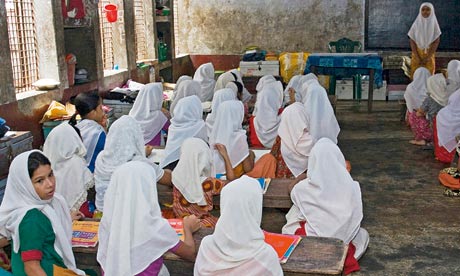
Huzoor Saleh takes us to the classrooms. We begin with the seven- to nine-year-olds. They are sitting on the floor of a large room, identical in size to Huzoor Saleh's office upstairs. They don't have classes today, and they are dressed casually in salwar kameezes, their heads wrapped in dupattas. They giggle as we enter. We are told by the teacher that they eat, sleep and study in this one room. When the classes are in session, they bring in the wooden benches that are stacked up in the hallway and arrange them in rows, then pile their things – blankets, clothes, mattresses, trunks and schoolbooks – at the back of the room. At night they sleep on the floor, three or four huddled under each mosquito net.
I see the girl who greeted me in the hallway. She gives me a tentative wave. When I squat next to her, the other girls turn to stare, so I have to whisper. Her name is Rabeya. She has a deep, pleasant voice. When did she come here, I ask. Three years ago. Her mother sold puffed rice at their village market. One day she told Rabeya she couldn't afford to feed her any more. Rabeya spent the next few months eating every third day. Then she heard of the madrasa. "My mother said, if you want to study, study and don't come back." Rabeya doesn't go home for the holidays like some of the other children. Chittagong is too far away, and she doesn't know if her mother is still at the old address.
The girls are shy at first, but Snigdha's camera pulls them towards us, and before long they are crowded around her, asking to see the photos she has taken in the small screen on her digital camera. In the maths classroom, a man referred to as Sir is teaching algebra. He explains the equation and they repeat after him. I have squeezed myself on to one of the benches. The girl sitting next to me, her pen moving quickly as Sir solves his quadratic equation, casts shy glances in my direction. Her name is Ayesha. I ask her about her textbooks. "What's this one?" "Science." And this? "Fiqh. It teaches you how to be a good Muslim." "Like rules?" I ask. "Yes, rules, how to conduct yourself, and how to be pious, and how to show your faith." "Are there separate rules for girls and boys?" "It's the same book for girls and for boys."
"But are the rules the same?" She looks very seriously at me, adjusting the white headscarf that is pinned neatly under her chin. "In Islam, a man and a woman are equal."
Chastised, I turn my attention back to Sir. We make our way downstairs, to a Quranic study class. This looks more as I had imagined, the children hunched over their Arabic texts, rocking back and forth as they read. The teacher sits at the front of the class with a long stick, which she bangs on the floor. "Recite!" she says, echoing the first word of the Qur'an. The children begin again, chanting, swaying, pointing to each word with an index finger. The younger children have shorter books. I whisper to the one nearest to me. "What are you reading?" "Ampara," she says. "What does it say?" The teacher approaches me. "We don't teach them the meaning until they're older." How old? "Class six."
A few weeks later, Ramadan, the month of fasting, has begun. The shops in Dhaka play tapes of Quranic recitation instead of pop music, and very early in the morning the muezzin outside my window urges me to wake, eat and prepare for a day without food and water. "Muslims, wake your neighbours!" the muezzin cries. In the afternoon, Snigdha and I relax with some of the older children in their dormitory. They are accompanied by one of their house mothers, Sultana. I am reminded of last year, when I visited a village school in one of the poorest corners of Bangladesh. I remember asking one of the children to recite a poem for me, and hearing him sing it in long, soaring notes full of tenderness. I asked Sultana if the children are allowed to sing, fully expecting her to give me a shocked no.
"They can sing," she said. "They sing ghazals."
"Ghazals, really?" I reply, thinking of the devotional, but often subversive Urdu lyric poetry.
"We hold competitions," Sultana said, "every year. With prizes."
She asks the children to sing, and one of the older girls gets up in front of the class. She sings in Bengali, a very plain devotional song. It lacks the poetry and subtlety of a ghazal, but the children appear to enjoy it, clapping and humming along. "I wish they had somewhere to play," Sultana sighs. "Sometimes we just let them run up and down the corridors to get some exercise." Snigdha snaps a few more photographs, and we take our leave for the day, promising to return as the children grasp and hug us goodbye.
I've grown attached to my visits to the Rehmat Ali mission, but I can't help but wonder if it's a typical example of madrasa education. Huzoor Saleh seems like any other school principal, pacing the corridors with a slightly worried expression on his face. The girls, despite their close confinement, seem at ease in their environment. They have an air of dignity about them, and they always, whenever I ask, tell me how eager they are to pass their exams and find work. I had ambitions of finding a different sort of madrasa, one in which images are banned and there are no singing competitions. The Rehmat Ali School is an Alia madrasa, and because it is monitored by the state, its activities have to be somewhat transparent. I want to find a Quomi madrasa, but my efforts seem jinxed; one visit after another is cancelled.
Finally, weeks later, I find myself in a rough part of Old Dhaka, not too far from the riverbank where the city was first built, waiting for a man to take me inside a building with a locked gate. The man, called Mithu, doesn't show up. Snigdha and I wait in the heat. Finally, we decide to venture out and find a madrasa that might let us inside. They're practically on every corner, and as we walk we find three or four within a few minutes.
We knock on doors and get turned away. Many of the schools are closed because of Ramadan. Without an introduction, it is impossible to find anyone who will allow us to enter. We finally persuade the principal of a new madrasa to speak with us. His students haven't arrived yet, but he grants us permission to look around. His office is in a newly constructed building, the walls and floors unplastered. We climb a set of rough concrete stairs to his office on the top floor. He is sitting behind a computer. His room is air-conditioned and smells sweetly of rosewater.
The meeting starts well. Huzoor Mansur has invented a new kind of teaching method, one that combines state education with madrasa education. He believes there should be a balance between the two; he complains that secular education does not have enough of an Islamic component. And madrasa students need to be able to get jobs, to operate in the larger social world. Then I ask what he thinks of girls' education, and why he is planning to allow women to attend his madrasa.
"Women are required for certain jobs," he begins. "When women ask me, about the colour of menstrual blood, I have to reply. When they ask, is it supposed to be reddish, or the colour of mud, what am I supposed to say? I can only tell them what I have read. That is why more women need to be educated. Women are falling behind." He tells us a bit more, about the seven colours of menstrual blood. Apparently there are books dedicated to this subject, all of which he has read. The Huzoor spends another five minutes explaining, in exacting detail, the need for women gynaecologists. He's polished and articulate, and I can't exactly disagree with what he's saying, bemoaning the lack of facilities, the dearth of good female teachers. But there's something menacing about the way he's talking, and I wonder if he's secretly having a laugh at us, Snigdha and I, both of us with our heads covered, our shoes removed, being savaged by the mosquitoes that swarm under his desk. We wait patiently until the Huzoor has finished, then we take our leave as quickly as we can. We make haste down the steps and into the street, but not before we catch a glimpse of the dormitories – dark, cramped rooms stacked high with bunk beds. Whatever the Huzoor will teach, whatever his mix of Islamic and secular, the children in his charge will have little means to challenge it. After all, he'll be feeding them three meals a day.
As we wind our way through the small roads of old Dhaka, we pass a street of shops selling large vats of chemicals, destined for the tanneries that line the riverbank. Then we catch a glimpse of the river itself, the mighty Buriganga on which Dhaka was originally built, and we come upon an arched walkway leading into a courtyard. I recognise the building as none other than Bara Katara, the oldest building in Dhaka.
On the face of it, Bara Katara is a symbol of everything that is wrong with Bangladesh. Although it is more than 500 years old, it has long been neglected by authorities. Its Mughal architecture – arched columns, sweeping courtyards, a grand gated entrance – has all but disappeared. The riverbank on which it sits once boasted palaces and mansions, but is now the place from which leather factories deposit their toxic chemicals into the river. And, though Bara Katara was built to house the sailors and merchants who came to Bengal to trade, it is no longer a way station for wanderers from afar – it is now home to one of Dhaka's largest madrasas. I look at the building and feel a mixture of things; sadness at the sorry state it is in, anger because I don't want it to turn into another madrasa; yet I know the building is alive because children walk its hallways and corridors, and without them, perhaps it would have crumbled away altogether, sliding into the murk of the river.
The madrasas I visited were both like and unlike what I had imagined. There were all the things my cousin had described – the rote learning, the squalid conditions, the lack of facilities. There was even, in the face of Huzoor Mansur, more than a hint of darkness. The institutions themselves were mysterious and closed to me, each visit closely monitored and controlled. But they did not contain the seeds of change I had feared (and, yes, morbidly expected) I would find. They were not places that threatened to educate a generation of scholars who would challenge my secular freedoms. I believe now that the Rehmat Ali mission is the product of what is really the main story in Bangladesh: poverty. Rabeya and Ayesha are at the mission because they are poor, because the mission is the only place where they are sure to be safe, from hunger, from abandonment, from predators. Just down the road from where we were parked in Old Dhaka is one of the biggest brothels in the city, home to countless young girls who have fled or been lured from their rural homes. Missions such as Huzoor Saleh's remain among the few places where a poor young woman can rise above the circumstances of her birth. It is no coincidence that the madrasa reminds me of Brontë; the gothic, in all its darkness and horror, is still a reality here. Huzoor Saleh's girls marry well; they take jobs at colleges and universities. Some even become scholars. There is something in my spirit that rebels when I walk through those dark-green corridors, but it is a rebellion against the fact that this place needs to exist at all, because, for so many in Bangladesh there is no alternative.
I did not find the cradle of fundamentalism at the Rehmat Ali school. Perhaps it is precisely because the school is dedicated to the education of girls that, as an institution, its aims are not political, nor even particularly religious, but simply humanitarian. While the threat of radical Islam is still real in Bangladesh, it is overwhelmed by the pressing challenges of poverty. And this, ultimately, is the most dangerous thing about Bangladesh. Not the threat of suicide bombers, but the everyday cruelty – the very radical, the very extreme cruelty, that its citizens have to survive, and bear, and overcome.
Eid is approaching. Every day after sunset, the stores and malls in Dhaka are heavy with frantic shoppers; billboards display the latest in Eid fashion. At the Rehmat Ali madrasa, Huzoor Saleh is sorting through his donations. Twice a year, his students are given a new set of clothes and a special Eid meal. If he can afford it, he gives the poorest students a bar of soap and a small bottle of hair oil. I have come to take my leave, and I offer him a small donation, saying, as is customary, that he should use the money to buy mishti, or sweets, for the children. "I'll buy some guava," he says, smiling. "Fruit is better for them."
Sunday, May 22, 2011
Radicalism, fundamentalism and discriminatory education
Hafid Abbas, Jakarta | Sat, 05/21/2011 8:00 AM | Opinion
On April 19 at the Bogor Palace, President Susilo Bambang Yudhoyono said that radicalism, terrorism and sectarian conflicts were three problems disrupting our national security.
This condition may have been triggered by a number of organizations and individuals who defied law enforcement. For that reason, security forces must act decisively and professionally in combating terrorism and several cases of violence in the name of religion that have occurred recently in Indonesia.
The President's concern is not without any reason. Indonesia has been undergoing many traumatizing events in the form of terror attacks.
One year after the 9/11 tragedy, Indonesia was shocked by the Bali bombings on Sept. 12, 2002. Since then, violence has endlessly hit the country, the most recent being the suicide bombing at the Cirebon Police mosque last April.
Although the acts of terrorism could be classified as large-scale and sophisticated, the police can quickly discover and arrest the perpetrators. Even those perpetrators have already been prosecuted and some of them sentenced to death.
The question then arises as to why radicalism and terrorism persists even though the police have always uncovered the cases and caught the perpetrators.
A security approach is likely successful in the short run, but in the long run, radicalism may arise again because the root of the problem remains untouched. The root of radicalism is abstract and embedded in the mind of a person.
Borrowing Gandhi's view, in this world there are two types of violence: physical violence such as terrorism and war, and soft violence such as defamation and provocation. Relations between the two, Gandhi says, are like fire and gasoline. In order to stop physical violence such as terrorism, people have to first remove radicalism and fundamentalism from their minds.
To create peace and tolerance in the mind of children is not an easy task. It requires a good education which can stimulate a favorable environment for children to gain knowledge, a positive attitude and rational behavior to address their social reality peacefully. Education must therefore broaden the horizon of children to acquire a sense of universal peace, internalize the value of tolerance and enable them to view things from different perspectives of truth.
To arrive at such circumstances, the process of education must meet a certain quality standard to stimulate students' minds to act and behave in a peaceful and tolerant manner to plurality and differences. Students need enough exercises to harmonize what they think, what they say and what they do to experience the universal beauty of peace.
However, on the other hand, that expectation is not without obstacles. Currently, approximately 88.8 percent of schools in Indonesia, ranging from elementary to high school have not passed the minimum service quality standard (Kompas, March 23, 2011).
The situation is probably even much worse at religious schools or madrasah.
Katarina Tomasevski (2002), the UN Special Rapporteur on education in Indonesia, exposed that only about 3 percent of students in Indonesia could enjoy an international standard or high quality of education. These schools are generally dominated by students of Chinese descent. On the other hand, this ethnic group is a source of social envy because they control the largest chunk of the economic pie.
Jealousy and discrimination triggered by discrimination, poverty and unemployment often cumulatively appear to be great power on the grounds of jihad against law enforcement agencies and other religious followers or ethnic groups who are part of the upper socio-economic class.
The existing radicalism is not a simple process. It has been likely triggered to the past dichotomy of education policy. Public schools under the National Education Ministry and private religious school under the Religious Affairs Ministry, despite their use of the same national curriculum, are extremely different in the way each treats resource distribution.
Madrasah under the religious ministry in the past appeared to be the last receiving hand of national budget allocation on education. The discrimination policy is presented by the ADB publication, "Financing of Education in Indonesia" (1999). For example, the unit cost for upper secondary school students under the religious ministry, Madrasah Aliyah (MA), is Rp 185,000 (US$21.76), about Rp 4,000 from the state budget and Rp 181,000 from parents. The unit cost of public senior high schools under the education ministry reached Rp 418,000, about Rp 333,000 from the state budget and Rp 85,000 from parents.
Similar discrepancies also appear in textbook distribution, teacher availability and infrastructure. Ironically, 60 percent of schoolchildren at madrasah are girls, who are among the most disadvantaged socio-economic strata, while those in public schools are from middle and upper classes.
As a result, almost all madrasah are continuously marginalized, as the poor subsidizes the rich in the way the lion's share of government subsidy goes to public schools. So, what can we expect from such circumstances if not just adding to potential social tension and vulnerability in the future.
The polarization gap between the education and religious ministries in dealing with national education has shown great lessons learned. The gap between the two has gradually improved and the past discrimination has changed gradually after the enactment of the 2003 National Education System Law, which allows all children in madrasah to be treated equally as those in public schools under the education ministry.
However, this transformation process seems to have problems due to many overlapping structural bureaucracies at the two ministries and other relevant agencies both at central and district levels. Madrasah transformation moves very slowly.
Bureaucracy reform at the two ministries appears to be greatly demanded with strong vision and decisive policy, including the need to merge all issues, concerns and problems of madrasah into one single management under the National Education Ministry.
The writer is a professor at the State University of Jakarta and former director general of human rights protection.
On April 19 at the Bogor Palace, President Susilo Bambang Yudhoyono said that radicalism, terrorism and sectarian conflicts were three problems disrupting our national security.
This condition may have been triggered by a number of organizations and individuals who defied law enforcement. For that reason, security forces must act decisively and professionally in combating terrorism and several cases of violence in the name of religion that have occurred recently in Indonesia.
The President's concern is not without any reason. Indonesia has been undergoing many traumatizing events in the form of terror attacks.
One year after the 9/11 tragedy, Indonesia was shocked by the Bali bombings on Sept. 12, 2002. Since then, violence has endlessly hit the country, the most recent being the suicide bombing at the Cirebon Police mosque last April.
Although the acts of terrorism could be classified as large-scale and sophisticated, the police can quickly discover and arrest the perpetrators. Even those perpetrators have already been prosecuted and some of them sentenced to death.
The question then arises as to why radicalism and terrorism persists even though the police have always uncovered the cases and caught the perpetrators.
A security approach is likely successful in the short run, but in the long run, radicalism may arise again because the root of the problem remains untouched. The root of radicalism is abstract and embedded in the mind of a person.
Borrowing Gandhi's view, in this world there are two types of violence: physical violence such as terrorism and war, and soft violence such as defamation and provocation. Relations between the two, Gandhi says, are like fire and gasoline. In order to stop physical violence such as terrorism, people have to first remove radicalism and fundamentalism from their minds.
To create peace and tolerance in the mind of children is not an easy task. It requires a good education which can stimulate a favorable environment for children to gain knowledge, a positive attitude and rational behavior to address their social reality peacefully. Education must therefore broaden the horizon of children to acquire a sense of universal peace, internalize the value of tolerance and enable them to view things from different perspectives of truth.
To arrive at such circumstances, the process of education must meet a certain quality standard to stimulate students' minds to act and behave in a peaceful and tolerant manner to plurality and differences. Students need enough exercises to harmonize what they think, what they say and what they do to experience the universal beauty of peace.
However, on the other hand, that expectation is not without obstacles. Currently, approximately 88.8 percent of schools in Indonesia, ranging from elementary to high school have not passed the minimum service quality standard (Kompas, March 23, 2011).
The situation is probably even much worse at religious schools or madrasah.
Katarina Tomasevski (2002), the UN Special Rapporteur on education in Indonesia, exposed that only about 3 percent of students in Indonesia could enjoy an international standard or high quality of education. These schools are generally dominated by students of Chinese descent. On the other hand, this ethnic group is a source of social envy because they control the largest chunk of the economic pie.
Jealousy and discrimination triggered by discrimination, poverty and unemployment often cumulatively appear to be great power on the grounds of jihad against law enforcement agencies and other religious followers or ethnic groups who are part of the upper socio-economic class.
The existing radicalism is not a simple process. It has been likely triggered to the past dichotomy of education policy. Public schools under the National Education Ministry and private religious school under the Religious Affairs Ministry, despite their use of the same national curriculum, are extremely different in the way each treats resource distribution.
Madrasah under the religious ministry in the past appeared to be the last receiving hand of national budget allocation on education. The discrimination policy is presented by the ADB publication, "Financing of Education in Indonesia" (1999). For example, the unit cost for upper secondary school students under the religious ministry, Madrasah Aliyah (MA), is Rp 185,000 (US$21.76), about Rp 4,000 from the state budget and Rp 181,000 from parents. The unit cost of public senior high schools under the education ministry reached Rp 418,000, about Rp 333,000 from the state budget and Rp 85,000 from parents.
Similar discrepancies also appear in textbook distribution, teacher availability and infrastructure. Ironically, 60 percent of schoolchildren at madrasah are girls, who are among the most disadvantaged socio-economic strata, while those in public schools are from middle and upper classes.
As a result, almost all madrasah are continuously marginalized, as the poor subsidizes the rich in the way the lion's share of government subsidy goes to public schools. So, what can we expect from such circumstances if not just adding to potential social tension and vulnerability in the future.
The polarization gap between the education and religious ministries in dealing with national education has shown great lessons learned. The gap between the two has gradually improved and the past discrimination has changed gradually after the enactment of the 2003 National Education System Law, which allows all children in madrasah to be treated equally as those in public schools under the education ministry.
However, this transformation process seems to have problems due to many overlapping structural bureaucracies at the two ministries and other relevant agencies both at central and district levels. Madrasah transformation moves very slowly.
Bureaucracy reform at the two ministries appears to be greatly demanded with strong vision and decisive policy, including the need to merge all issues, concerns and problems of madrasah into one single management under the National Education Ministry.
The writer is a professor at the State University of Jakarta and former director general of human rights protection.
Sunday, May 08, 2011
كلمة ولو جبر خاطر وإلا سلام من بعيد
كلمه ولو جبر خاطر
ولا سلام من بعيد
ولا رساله ياهاجر
في يد ساعي البريد ........
انا في انتظارك
تقابلني وتسمع قصتي حتى النهايه
وانت اختيارك
تسامحني اذا حبيت او تنسى هوايه
حرام كسر الخواطر
وذا الجفا مايفيد .........
ايش من ذنب عندي
استاهل عليه هجرك والعناد
يلي خنت عهدي
بعت الود ليه بعد الوداد
حرام مادمت صابر
تهجرني تبعد بعيد ........
وان كنت ناوي تعذبني
انا راضي بتعذيبك واحبه
من مثلك انته يطلعني
ومن يقدر يخليني احبه
حرام كسر الخواطر
وذا الجفا مايفيد .......
مقادير
مقادير
مقادير ياقلبي العنا
مقادير وش ذنبي أنا
مقادير و تمضي حياتي
مشاوير و أتمنى الهنا
على ميعاد حنا و الفرح كنا
و كنا بعاد وعشنا على الأمل حنا
و كان الفرح غايب
و اثر الأمل كاذب
مقادير
يا أهل الهوى كيف المحبة تهون
كيف النوى يقدر ينسى العيون
نظرة حنين و أحلى سنين
عشناها عشناها يا قلبي الحزين
مقادير
Thursday, April 21, 2011
Kardinah di Bawah Bayangan Kartini
Kamis, 21 April 2011 - 20:44:45 WIB
Selain Rumah Sakit Umum di Tegal yang meminjam namanya, hampir tak ada monumen atau apapun yang bisa membuktikan perjuangan adik Kartini ini.
NAMANYA nyaris berada di bawah bayang-bayang kebesaran nama kakaknya, Kartini. Padahal perjuangannya dalam meninggikan derajat perempuan dan menolong kaum lemah tak bisa dibilang sedikit. Salah satu penyebabnya, Kardinah tak seerat Kartini dalam bersahabat dengan Nyonya Abendanon atau Nyonya Ovink-Soer.
Lahir di Jepara pada 1 Maret 1881, Kardinah merupakan anak ke-7 Bupati Jepara RM Sosroningrat. Dia anak pertama dari selir (garwa ampil) bupati bernama M.A. Ngasirah.
Ayahnya selalu menularkan kepekaan sosial kepada anak-anaknya. “Setelah sudah agak besar, kami sering disuruh oleh rama (bapak) untuk ikut meninjau tempat-tempat penderitaan rakyat. Maksud rama supaya kami melihat sendiri dari dekat bencana-bencana yang menimpa rakyat itu dan mendapat kesan bagaimana susahnya hidup mereka yang melarat dan hina itu,” tulis Kardinah dalam suratnya tanggal 25 Maret 1964 kepada Sitisoemandari Soeroto, penulis Kartini Sebuah Biografi.
Selain memberikan pendidikan formal seperti ELS (Europese Lagere School), ayahnya memanggilkan guru ke rumah. Bersama saudara-saudaranya, mereka membaca, belajar, dan berdiskusi. Mereka kemudian bercita-cita untuk memberikan pendidikan bagi anak-anak perempuan.
Setelah menikah dengan Patih Soejitno, anak Bupati Tegal Ario Reksonegoro, pada 24 Januari 1902, Kardinah mulai mewujudkan cita-cita Het Klaverblad (daun semanggi) atau “Tiga Saudara” –julukan yang Nyonya Ovink-Soer, istri asisten residen Jepara, berikan kepada Kartini, Rukmini, dan Kardinah.
“Kardinah yakin posisi sosialnya mewajibkannya untuk melakukan sesuatu bagi masyarakat –sebagai bentuk tanggung jawab itu, sebagaimana saudara perempuannya, Roekmini, dia berpikir bahwa tidak semestinya orang asing saja yang harus berbuat, meski jelas sekali mereka juga punya tanggung jawab– juga merefleksikan peran politik dalam komunitas politik Jawa secara umum," tulis Joost Coté dalam Realizing the dream of R.A. Kartini: Her Sisters' Letters from Colonial Java.
Kardinah menggunakan model pendidikan yang digariskan Kartini: ibu menjadi pusat kehidupan rumah tangga. “Tak ada yang lebih baik daripada pendidikan seorang ibu yang telah tercerdaskan,” tulis Ahmad Fatkhudin dalam skripsinya di Jurusan Ilmu Sejarah Universitas Diponegoro, “Kardinah Reksonegoro, Peranan dan Pemikirannya dalam Pengembangan Masyarakat Tegal Tahun 1908–1945”.
Kardinah tak puas terhadap kebijakan pemerintah kolonial yang membatasi akses pendidikan kaum bumiputera. Hanya anak bangsawan yang bisa mendapatkan pendidikan baik dengan bahasa Belanda sebagai bahasa pengantar. “Berapa banyak bangsa kami, saya bertanya pada diri sendiri, yang mampu untuk belajar di sekolah-sekolah seperti itu?” tulis Kardinah dalam suratnya kepada Nyonya Abendanon tanggal 15 Juli 1911. Lebih lanjut, “Apakah itu adil? Atau apakah yang seharusnya menjadi contoh bisa membantu masyarakat pribumi untuk maju?”
Banyak priyayi, termasuk bupati Pemalang, tertarik dengan model pendidikan yang Kardinah lakukan di rumahnya. Mereka menitipkan anak-anak mereka. Bersama suaminya, yang pada 8 Juli 1908 diangkat jadi bupati Tegal, Kardinah berjuang mendirikan sebuah sekolah. “Kini suami dan saya mempunyai rencana untuk mendirikan sebuah sekolah sendiri bagi anak-anak pejabat bawahan dari sumbangan-sumbangan kolektif,” tulis Kardinah kepada Abendanon dalam suratnya tanggal 15 Juli 1911, sebagaimana dimuat dalam Surat-surat Adik R.A. Kartini karya Frits G.P. Jaquet.
Untuk mewujudkannya, Kardinah mengumpulkan dana dari penjualan bukunya; dua jilid buku memasak dan dua jilid buku mengenai batik. Dia juga mendapat bantuan dana dari istri Asisten Residen Tegal HM de Stuers, istri kontrolir Tegal E. van den Bos, dan istri Patih Tegal Raden Ayu Soemodirdjo. Kardinah lalu mendirikan sekolah kepandaian putri Wismo Pranowo (WP) pada 1 Maret 1916. Biaya operasional ditanggung masyarakat yang mampu, selain dari hasil pasar amal dan sumbangan. Segala keperluan sekolah diberikan secara cuma-cuma. Tiap murid hanya dibebankan uang sekolah 50 sen.
Mata pelajaran di WP antara lain bahasa Belanda, dasar pendidikan kebangsaan dan kebudayaan Jawa, Pertolongan Pertama pada Kecelakaan (P3K), mengaji Alquran, membatik, dan pendidikan watak. Kardinah ikut mengajar. Begitu pula Ki Hajar Dewantoro. Meski menggunakan sistem pendidikan yang ditetapkan Kartini, WP bukan Sekolah Kartini karena biaya operasional tak ditanggung gubernemen.
Awalnya sekolah itu hanya menempati bekas gedung kantor kabupaten, dengan murid 150 orang. Tapi tahun 1924 sudah terdapat 200 murid dan enam ruang belajar. Banyak pihak tertarik dengan model pendidikan WP. Dewi Sartika, tokoh pendidikan Priangan, salah satunya. Bersama adiknya, Sari Pamerat, dia berkunjung ke Tegal untuk mempelajari sistem pendidikan WP. Mereka juga ikut mengajar selama empat bulan. Pemerintah akhirnya mengambil-alih sekolah itu dan mengubahnya jadi Kopschool (sekolah kejuruan bagi kaum perempuan) dan Onderbouwschool (sekolah rendah)– pada 24 Oktober 1924 dengan kompensasi f 16.000.
“Saya merasa ini sebagai tugas saya, tugas suci saya kepada saudari kami, yang dengannya kami pernah memimpikan mimpi itu, yang dengannya kami membangun cita-cita itu, dan menawarkan diri saya sekarang untuk tujuan yang kami selalu tuju, demi kebaikan kita semua,” tulis Kardinah dalam suratnya kepada Nyonya Abendanon.
Bersama kakaknya, Sosro Kartono, Kardinah juga mendirikan sebuah perpustakaan yang diberi nama Panti Sastra. Dananya didapat secara swadaya.
Kardinah juga prihatin dengan kondisi kesehatan rakyat di Tegal, terutama ketika tahu murid-muridnya melahirkan tanpa dukungan tenaga dan fasilitas memadai. “Orang sakit kok ditidurkan di tikar, bagaimana itu?” ujar Kardinah tak puas. Dia mencurahkan perhatiannya pada dunia kesehatan, dengan membangun fasilitas kesehatan dan memperbaiki pengetahuan medis masyarakat yang kala itu lebih percaya pada klenik.
Pada 1927 Kardinah mendirikan Kardinah Ziekenhuis atau Rumah Sakit Kardinah. Dana dari kompensasi WP dan hasil penjualan buku-bukunya serta keuntungan penjualan kerajinan tangan buatan murid-murid WP. Residen Pekalongan Schilling termasuk orang yang mendukung niatnya dengan membantu pendanaan. Schilling pula yang minta rumah sakit itu dinamai Kardinah. Pemerintah pusat dan daerah ikut mensubsidi. Rumah Sakit Kardinah, "merupakan lambang pengabdian yang nyata dari Tiga Saudara kepada kemanusiaan, seperti yang mereka idam-idamkan bersama,” tulis Fatkhudin.
Tak lama kemudian Kardinah juga membangun sebuah rumah penampungan bagi orang-orang miskin di sekitar Kardinah Ziekenhuis.
Pemerintah Hindia Belanda mengapresiasi jasa-jasa Kardinah dengan menganugerahkan bintang Ridder van Oranje Nassau –pemerintah Indonesia sendiri pada 21 Desember 1969 menganugerahkan Lencana Kebaktian Sosial Republik Indonesia.
Tak lama setelah Indonesia merdeka, diikuti revolusi sosial di berbagai daerah, Kardinah dan keluarganya ditangkap Gerombolan Kutil. Kardinah dan keluarganya dianggap lambang feodalisme. Selain diancam akan dibunuh, mereka dipakaikan baju dari goni lalu diarak keliling kota. Sejak itu keberadaan Kardinah tak diketahui.
Menurut Anton Lucas dalam Peristiwa Tiga Daerah, setelah ditangkap dan diarak keliling kota, arak-arakan berhenti di depan RS Kardinah. Mereka lalu dibawa dengan sebuah truk ke Talang dan ditahan di rumah Wedana Adiwerna selama seminggu. Para priyayi Pekalongan dan perwira Tentara Keamanan Rakyat, yang menganggap tindakan Adiwerna tak sesuai norma-norma budaya Jawa, menyelamatkan Kardinah pada 13 November 1945. Kardinah lalu dibawa ke Salatiga.
Namun menurut Kardinah kepada Sumiati Sardjoe, istri walikota Tegal Sardjoe, kisahnya lain. Waktu dirinya diarak keliling kota, arak-arakan berhenti di depan Rumah Sakit Kardinah. Dia lalu pura-pura sakit dan dirawat. Malamnya dia diselamatkan orang-orang yang simpatik. Mereka membawanya ke Salatiga.
Titik terang datang pada 1970. Sumiati, yang gigih mencari keberadaan Kardinah, mendapat informasi ketika menghadiri pertemuan Gabungan Organisasi Wanita di Semarang: Kardinah tinggal di Salatiga. Awalnya dia tak bisa menemuinya karena Kardinah trauma setiapkali mendengar kata Tegal. Tapi akhirnya, setahun kemudian, Kardinah berkunjung ke Tegal atas undangan Sumiati. "Kedatangannya di Tegal disambut haru warga Tegal," tulis Fatkhudin. Kardinah memanfaatkan kunjungannya itu untuk berziarah ke makam suaminya.
Tak lama berselang, setelah kunjungannya itu, pada 5 Juli 1971 Kardinah wafat. Dia dimakamkan di samping makam suaminya. [MF MUKTHI]
Tuesday, April 19, 2011
Piwelingku

Urip iku mung sapisan nang alam dunya
aja dumeh lan aja nggege mangsa
aja dahwen lan aja nyolong dhuwekne liyan
Yen sira ora bisa anglakoni sabar
mangka urip iki dadi bubar ambyar
Nuruti lakune dunya
kang saya suwe saya akeh pratingkah
wong dipeksa dadi golek
lan dadi wayang saka kepentingane
wong kang dagang
urip mung dinggo ngumbar
nefsu angkara lan lawamah
muturut paugeraning doltinuku
Dunya iku tegese asor lan ora nduweni pitulung
Dunya iku bakal nulungi nalikane kawulane Allah
nulungi agamane Allah
Dunya dianggo mung netepi paugeraning agami
Sedekah, zakat, lan aweh pitulung marang kang butuh
ora numpuk dunya kanggo kasenengane sarira
Iku mung lumantaran kabegjan sejati
Monday, April 04, 2011
Islam is winning
Islam is winning
By Dr. Aaidh al-Qarni
O Muslims, don't lose heart, don't surrender. Allah is watching over us just as He watched over our forefathers. Don't you remember how our predecessors lived prior to Islam, and what they achieved after they embraced this faith? Prior to Islam, they worked as humble shepherds, but afterwards they become world leaders. Prior to Islam, they worshipped idols and believed in divination, but [after Islam] they went on to lead the world in knowledge, ruling wisely and justly. Therefore I say, don't lose heart, the secret of our renaissance, victory, pride, and sense of honour lies in the Holy Quran. This remains fresh in the hearts of our children, and the souls of our elders. The Holy Quran will instil life within us once more, and help us to regain our glory and victory. God brought us to life with the revelation of Islam at the dawn of the Islamic age, and he is capable of resurrecting us from our [current] slumber.
Our predecessors in pre-Islamic times used to believe in astrology, and plunder caravans and waylay travellers, living without values or virtue. They lived according to the law of the jungle, and were therefore immersed in backward practices and ignorance. They swore on the false [Meccan] idols of Al-Lat, Manat, and Al-Uzza, killing their own children, and attacking the unarmed. However everything in their lives changed after they converted to Islam. Their hearts became scriptures of guidance, their tongues pulpits of knowledge, their writings heralds of learning, whilst their words bore remembrance and recitation. They performed ablution and the gates of paradise open wide for them. They prayed and brought low mountains, they prostrated themselves in worship of God Almighty and tyrants fell in the face of their faith, whilst angels fought alongside them in battle, and the bastions of infidelity and falsehood were destroyed. These Muslims would exclaim "God is Great" and the thrones of tyrants shook beneath their feet, whilst the palaces of Emperors and Kings were destroyed.
They raised the banner of "There is no god but Allah" and the earth and sky welcomed them, with all territories succumbing to their rule. When Bilal [al-Habshi] first issued the call for prayer, the entire world bowed in supplication. When Abu Mousa recited verses of the Holy Quran, darkness was replaced by light, and when Abu Huraira narrated a Hadith time stood still; tyrants surrendered when Caliph Umar [Ibn al-Khattab] ruled, and infidelity and falsehood was crushed when Khalid [Ibn al-Walid] went to war.
O Muslims, don't give in, our faith commands the greatest number of followers and covers a vast region of the world. In every corner of the world you can find a Muslim; in every mosque you would find a believer praying; on every hill you can find a [Muslim] cleric ready to offer his advice. There is not a singe town comes without a mosque; not a single village without a prayer room, and there is not a single country around the world that does not have an Islamic centre and institution. Mountains, lowlands and hills all shake with the most righteous call: God is the Greatest! God is the Greatest! Seas, wastelands and the whole earth all cry out in awe: There is no god but Allah!
O Muslims, we might be weak but not dead, sick but not bedridden, defeated but not vanquished. The spark of life, the seed of challenge, refusal to submit, the fuel of the revolution and the spirit of struggle, all of them still exist in us. We are the recipients of the eternal message, the upholders of a just cause and the builders of a cultural divine project. Had we not been at the core of the world's attention, no one would have busied themselves with us. We are coming, that is why the others fear us. We are not a Pan-nationalistic race or a national party or an underground ideology or a political group.
We are a great nation with a noble message and a set of moral principles. We are Arabs and non-Arabs, black and white, clerics and masses, rich and poor. We are the conscience of the world, the delight of this life and the hope of oppressed peoples. We are a grand charitable society and a chief international institution. We are the voice of salvation in the conscience of the unseen, a smile of hope on the mouth of time and a firebrand of God's Light in a labyrinth. We declared there is only one God when others turned atheists; we became believers the day others disbelieved.
We sin but repent, err but ask for forgiveness. If we stumble, Almighty God raises us from our trips; if we lose, Almighty God renders us victorious and if the world comes tumbling down on us, Almighty God reaches out a Hand. To God we shall return, in God's Company we rest, in God's Wisdom we trust, to God we commit our souls and in the Way of God we struggle. We are the nation of the last Prophet. The Revealed Books were sealed with our Quran. We are the nation of moderation which rectified the path of humanity; the witnessing nation which holds the conclusive testimony; the nation of Jihad which trample over falsehood; we are a nation put to the test by God; a nation which has served as a test to others; we are the nation of moral constitution; the nation of Kiblah, faith and Sunna. The moral constitution is our belief in Allah as one God, our Kiblah is Mecca, our faith is Islam and our Sunna is to follow the infallible Prophet's way of life.
We are the people of the Two Kiblahs, the Two Pledges of Allegiance, the Two Rewards, and the Two Hegiras and the Two Epics. The Two Kiblahs are the Kaaba and the Aqsa Mosque, the Two Pledges of Allegiance are those of al-Aqaba and al-Ridwan, the Two Rewards are Victory or Martyrdom, the Two Hegiras are those of Ethiopia and Medina and the Two Epics are the Battle of Delegation and the Battle of Renewal.
We are mortals but God is immortal, we perish but the Holy Quran lasts, we die but the Prophetic Tradition remains: "So lose not heart, nor fall into despair: For ye must gain mastery if ye are true in Faith."
By Dr. Aaidh al-Qarni
O Muslims, don't lose heart, don't surrender. Allah is watching over us just as He watched over our forefathers. Don't you remember how our predecessors lived prior to Islam, and what they achieved after they embraced this faith? Prior to Islam, they worked as humble shepherds, but afterwards they become world leaders. Prior to Islam, they worshipped idols and believed in divination, but [after Islam] they went on to lead the world in knowledge, ruling wisely and justly. Therefore I say, don't lose heart, the secret of our renaissance, victory, pride, and sense of honour lies in the Holy Quran. This remains fresh in the hearts of our children, and the souls of our elders. The Holy Quran will instil life within us once more, and help us to regain our glory and victory. God brought us to life with the revelation of Islam at the dawn of the Islamic age, and he is capable of resurrecting us from our [current] slumber.
Our predecessors in pre-Islamic times used to believe in astrology, and plunder caravans and waylay travellers, living without values or virtue. They lived according to the law of the jungle, and were therefore immersed in backward practices and ignorance. They swore on the false [Meccan] idols of Al-Lat, Manat, and Al-Uzza, killing their own children, and attacking the unarmed. However everything in their lives changed after they converted to Islam. Their hearts became scriptures of guidance, their tongues pulpits of knowledge, their writings heralds of learning, whilst their words bore remembrance and recitation. They performed ablution and the gates of paradise open wide for them. They prayed and brought low mountains, they prostrated themselves in worship of God Almighty and tyrants fell in the face of their faith, whilst angels fought alongside them in battle, and the bastions of infidelity and falsehood were destroyed. These Muslims would exclaim "God is Great" and the thrones of tyrants shook beneath their feet, whilst the palaces of Emperors and Kings were destroyed.
They raised the banner of "There is no god but Allah" and the earth and sky welcomed them, with all territories succumbing to their rule. When Bilal [al-Habshi] first issued the call for prayer, the entire world bowed in supplication. When Abu Mousa recited verses of the Holy Quran, darkness was replaced by light, and when Abu Huraira narrated a Hadith time stood still; tyrants surrendered when Caliph Umar [Ibn al-Khattab] ruled, and infidelity and falsehood was crushed when Khalid [Ibn al-Walid] went to war.
O Muslims, don't give in, our faith commands the greatest number of followers and covers a vast region of the world. In every corner of the world you can find a Muslim; in every mosque you would find a believer praying; on every hill you can find a [Muslim] cleric ready to offer his advice. There is not a singe town comes without a mosque; not a single village without a prayer room, and there is not a single country around the world that does not have an Islamic centre and institution. Mountains, lowlands and hills all shake with the most righteous call: God is the Greatest! God is the Greatest! Seas, wastelands and the whole earth all cry out in awe: There is no god but Allah!
O Muslims, we might be weak but not dead, sick but not bedridden, defeated but not vanquished. The spark of life, the seed of challenge, refusal to submit, the fuel of the revolution and the spirit of struggle, all of them still exist in us. We are the recipients of the eternal message, the upholders of a just cause and the builders of a cultural divine project. Had we not been at the core of the world's attention, no one would have busied themselves with us. We are coming, that is why the others fear us. We are not a Pan-nationalistic race or a national party or an underground ideology or a political group.
We are a great nation with a noble message and a set of moral principles. We are Arabs and non-Arabs, black and white, clerics and masses, rich and poor. We are the conscience of the world, the delight of this life and the hope of oppressed peoples. We are a grand charitable society and a chief international institution. We are the voice of salvation in the conscience of the unseen, a smile of hope on the mouth of time and a firebrand of God's Light in a labyrinth. We declared there is only one God when others turned atheists; we became believers the day others disbelieved.
We sin but repent, err but ask for forgiveness. If we stumble, Almighty God raises us from our trips; if we lose, Almighty God renders us victorious and if the world comes tumbling down on us, Almighty God reaches out a Hand. To God we shall return, in God's Company we rest, in God's Wisdom we trust, to God we commit our souls and in the Way of God we struggle. We are the nation of the last Prophet. The Revealed Books were sealed with our Quran. We are the nation of moderation which rectified the path of humanity; the witnessing nation which holds the conclusive testimony; the nation of Jihad which trample over falsehood; we are a nation put to the test by God; a nation which has served as a test to others; we are the nation of moral constitution; the nation of Kiblah, faith and Sunna. The moral constitution is our belief in Allah as one God, our Kiblah is Mecca, our faith is Islam and our Sunna is to follow the infallible Prophet's way of life.
We are the people of the Two Kiblahs, the Two Pledges of Allegiance, the Two Rewards, and the Two Hegiras and the Two Epics. The Two Kiblahs are the Kaaba and the Aqsa Mosque, the Two Pledges of Allegiance are those of al-Aqaba and al-Ridwan, the Two Rewards are Victory or Martyrdom, the Two Hegiras are those of Ethiopia and Medina and the Two Epics are the Battle of Delegation and the Battle of Renewal.
We are mortals but God is immortal, we perish but the Holy Quran lasts, we die but the Prophetic Tradition remains: "So lose not heart, nor fall into despair: For ye must gain mastery if ye are true in Faith."
Subscribe to:
Posts (Atom)